

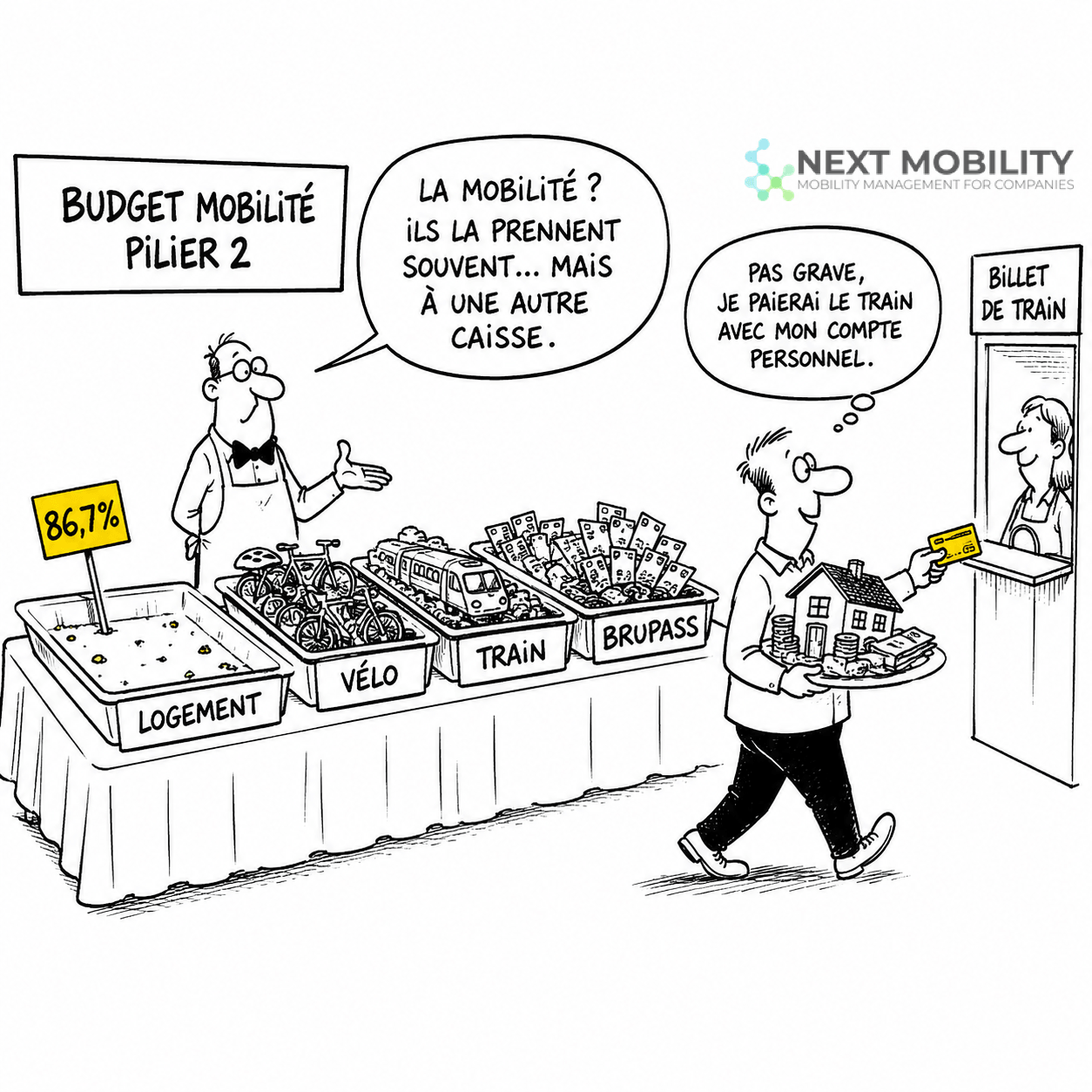
A KPMG study published this week in De Tijd puts the topic back on the table. Analysing anonymised Olympus Mobility data (302 employers, 4,389 employees), complemented by NSSO figures and interviews, it confirms an order of magnitude we have been measuring in the field for months: nearly three quarters of the employees who use the second pillar of the mobility budget spend it on their housing, and those costs account for 86.7% of the pillar’s spending.
The figure circulates widely, often with an implication: that the mobility budget is being diverted from its purpose. We do not share that reading. And the debate now opening, around a 50% cap, deserves better than a percentage picked out of thin air.
What the figures actually say
Let us set the framework. The mobility budget for companies is built on three pillars. The first finances an environmentally friendly company car (today, an electric vehicle). The second covers a broad range of sustainable mobility: public transport, bicycles, shared mobility and, under conditions, housing costs (rent or mortgage interest) for those living within a ten-kilometre radius of their main place of work or teleworking more than half the time. The third pillar pays out the balance in cash, subject to social contributions.
That 86.7% of the second pillar’s spending goes to housing is nothing abnormal. Housing is the largest expense of a Belgian household. As soon as a scheme allows it to be eased, people use it, and one understands why. Seeing abuse in this is aiming at the wrong target: the mechanism works exactly as the text allows.
The intention behind the cap holds up
The social partners want part of the budget to keep feeding mobility itself. That intention is defensible. A budget that ends up entirely in the rent gets no alternative tested. Part of the intended effect lies precisely there: getting someone to try an electric bike, a combined season ticket, a train trip instead of a flight, in short uses they would not have adopted spontaneously. Reserving a fraction for mobility keeps that door open. It can be understood.
The National Labour Council and the Central Economic Council, in their joint opinion No. 2,485 of 29 April 2026, translate that intention into a simple rule: limit housing costs to half of the budget. The opinion has not yet become law and has not been published in the Belgian Official Gazette; it is a proposal, not an adopted text.
The problem with the threshold: what does the “50%” rest on?
This is where we remain cautious. The 50% figure has the merit of being clear, but to our knowledge it rests on no measurement. Why half, and not 40% or 60%? If any data justifies this precise level, we would be the first keen to read it. As it stands, a percentage set by arbitration has a flaw: it gets renegotiated at every legislature, without anyone being able to say whether it is too high or too low, for lack of a yardstick.
A cap also answers a slightly skewed question. It asks “what maximum share may go to housing?”, whereas the real objective lies elsewhere: “does the budget still guarantee effective mobility?” That is not the same question, and it does not call for the same answer.
A different logic: the mobility floor
Rather than capping housing from above, one can guarantee mobility from below. The idea: define a floor of real mobility spending that the budget must first cover, with the balance free to go to housing. And that floor can be priced on costs that already exist.
Take a concrete case, in Brussels and its outskirts. A Brupass XL season ticket, covering STIB, TEC, De Lijn and the SNCB in and around the capital, costs 940 euros a year, or about 78 euros a month. Add an electric bike. On the merits, buying remains preferable to leasing: it is cheaper overall. But the mobility budget works on a calendar-year basis and does not allow a purchase to be amortised over several financial years; leasing, on the other hand, spreads the cost, in the region of 100 euros a month, maintenance and insurance included. It is a practical stopgap, and already a first rule that would benefit from being clarified. Finally, set aside a reserve for a long-distance train journey, for instance a Brussels-Marseille return trip for a family, around 1,200 euros over the year, or about a hundred euros a month.
This brings us to a floor of roughly 300 euros a month of effective mobility, that is nearly 3,600 euros a year. Above that, the budget can finance housing without raising any question, since mobility is guaranteed.
For reference, that amount is of the same order as an SNCB all-network season ticket, the Unlimited formula, which in 2026 costs 3,680 euros a year. In other words, the floor is nothing extravagant: it matches the real cost of genuine freedom of movement. It sits, moreover, just above the current legal minimum of the mobility budget, set at 3,233 euros (in 2026).
Why a floor beats a cap
Three very concrete reasons.
First, a floor is verifiable. It does not depend on a negotiated slider but on the real price of a season ticket, a lease, a ticket. Those amounts are public and indexed to the cost of living; the rule follows the real cost of mobility, not the mood of a budget conclave.
Second, it directly serves the original objective. Where a cap merely prevents, a floor encourages: it puts a season ticket and a bike into the worker’s hands, precisely the uses one hopes to see adopted. It does not restrict housing, it kick-starts mobility.
Third, it is legible for the employer. A floor is set once in the management tool; it requires no case-by-case arbitration. For an HR or fleet manager, it is a rule that simply applies, not one more file to handle.
What we observe on assignment
This logic is not theoretical. We put it in place at consultancy firms whose staff travel a lot and who insist that their consultants stay genuinely mobile, not just well housed. We have done so in very different contexts, for instance in our mobility budget implementation at Brightwolves or at Speos, each with its own constraints. Setting a mobility floor there answers a very practical need: ensuring a consultant always has a way to reach a client, whatever choices they have made with the rest of their budget.
The 50% is only the visible part
To be honest, the housing cap is the tree that hides the forest. If we want a mobility budget that holds up, several other rules would benefit from being clarified, and always on the same basis: figures, not sliders.
A TCO calculated as in real life. The budget amount derives from the total cost of ownership of the car the worker gives up. Except it must be calculated the way fleet managers do it day to day, on a realistic annual mileage package, and not on a theoretical formula disconnected from actual use, one that requires a personalised calculation per employee and scares everyone off.
An access rule that drives absurd arrangements. Take a worker entitled to both a company car and a public transport season ticket for their home-to-work commute. To keep that season ticket outside their mobility budget once they switch to it, the administration’s current interpretation requires that they have actually combined the two for at least three months. The consequence is visible in the field: some employers provide a temporary car for three months, together with a season ticket, for the sole purpose of preserving the later possibility of combining the two outside the budget. Conversely, the worker who gives up the car straight away to take the train has to finance their season ticket out of their budget. Two equally virtuous choices, treated differently, and an arrangement only large organisations can afford, not SMEs. Yet the law targets the worker who had a car “or was eligible for one”: that restrictive reading would, here too, deserve clarification.
The same limits on both sides. The mobility budget is capped at 20% of gross annual pay, with a floor and a ceiling. Why not apply exactly the same guardrails to the company car itself, the same percentage and the same minimum and maximum total cost of ownership? We would stop comparing two schemes with asymmetric rules.
The debate over the cap has only just begun, and it is healthy that it is taking place. Setting a percentage is quick. Anchoring it on real costs takes a little more work, but the rule then rests on something one can quantify, explain and defend.
To understand why housing costs sit within the mobility budget, and the role of remote work and the “main place of work”, see our earlier analysis: Mobility budget, housing costs and remote work: the real question.
Sources
- KPMG / Olympus Mobility study on the mobility budget (covered by De Tijd, July 2026): 302 employers, 4,389 employees; housing costs = 86.7% of pillar 2 spending; ~75% of pillar 2 users spend it on housing (~45% entirely).
- Joint CNT-CCE opinion No. 2,485 of 29 April 2026 (PDF, FR): proposal to cap housing costs at 50% of the mobility budget (not yet enacted, not published in the Official Gazette; qualitative justification, no measured threshold).
- STIB-MIVB, Brupass and Brupass XL fares: 12-month season ticket = €940.
- SNCB, Unlimited season ticket (product sheet, fare as of 01/02/2026): €3,680/year.
- o2o, cost of a bike lease in 2026: all-in bike lease (maintenance, insurance).
- SNCF Connect, Brussels-Marseille fares: one-way from ~€27-38 (Eurostar, TGV INOUI, OUIGO).
- Mobility budget conditions and amounts: access conditional on holding or being eligible for a company car (at least 3 months, and 12 months in the preceding 36); amount between €3,233 and 20% of gross annual pay, capped at €17,244.
- Combining a company car and a commuting season ticket outside the mobility budget (official FAQ): Law of 17 March 2019, art. 3, §1, 2° (“or was eligible for one”); NSSO interpretation requiring a prior effective combination of both benefits.
- Legal framework of the mobility budget — FPS Mobility: housing costs, 10 km radius or remote work > 50%.