

In the first quarter of 2026, 81,59 % of new company cars registered in Belgium were fully electric, compared with 10,54 % four years earlier. Taxation did what it was calibrated to do: move combustion engines out of fleets.
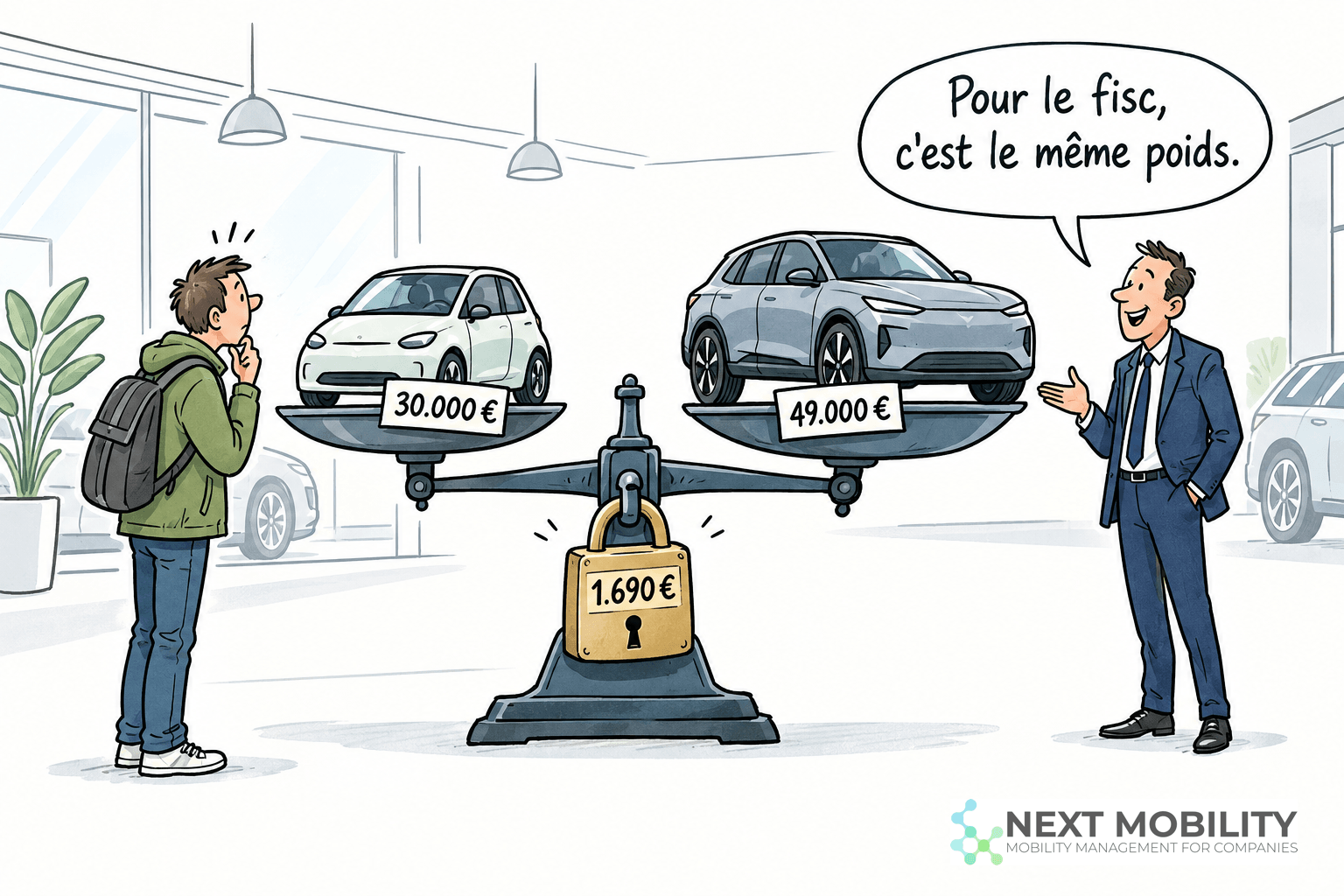
It was never designed, however, to pass on to employees the price of the car they choose. For an electric car the benefit in kind (BIK) is low, and below a certain price it does not move at all.
This article explains how the BIK of an electric car is calculated in 2026, where the threshold below which it is flat lies, why vans follow a different logic, and what this means in practice for a grid of job categories and for the mobility budget.
1. The formula
The BIK of a company car is calculated on an annual basis:
catalogue value × age coefficient × 6/7 × CO2 percentage
- The CO2 percentage starts from a base of 5,5 % and moves by 0,1 point per gram of CO2 above or below a reference emission set every year. It is capped between 4 % and 18 %. An electric car sits at the 4 % minimum.
- The catalogue value is the price of the new vehicle when sold to a private individual, including options and VAT actually paid, without discounts or rebates. Options therefore count in full: they are often what separates two cars in the same category.
- The age coefficient reduces the catalogue value as the car gets older (see the table further down).
- The employee’s personal contribution to the cost of the car is deducted from the BIK.
- A minimum amount applies.
For a new electric car, the formula simplifies to BIK = catalogue value × 3,43 %. Every 10.000 € of catalogue value adds 343 € of BIK per year.
2. The 1.690 € minimum and the 49.292 € threshold
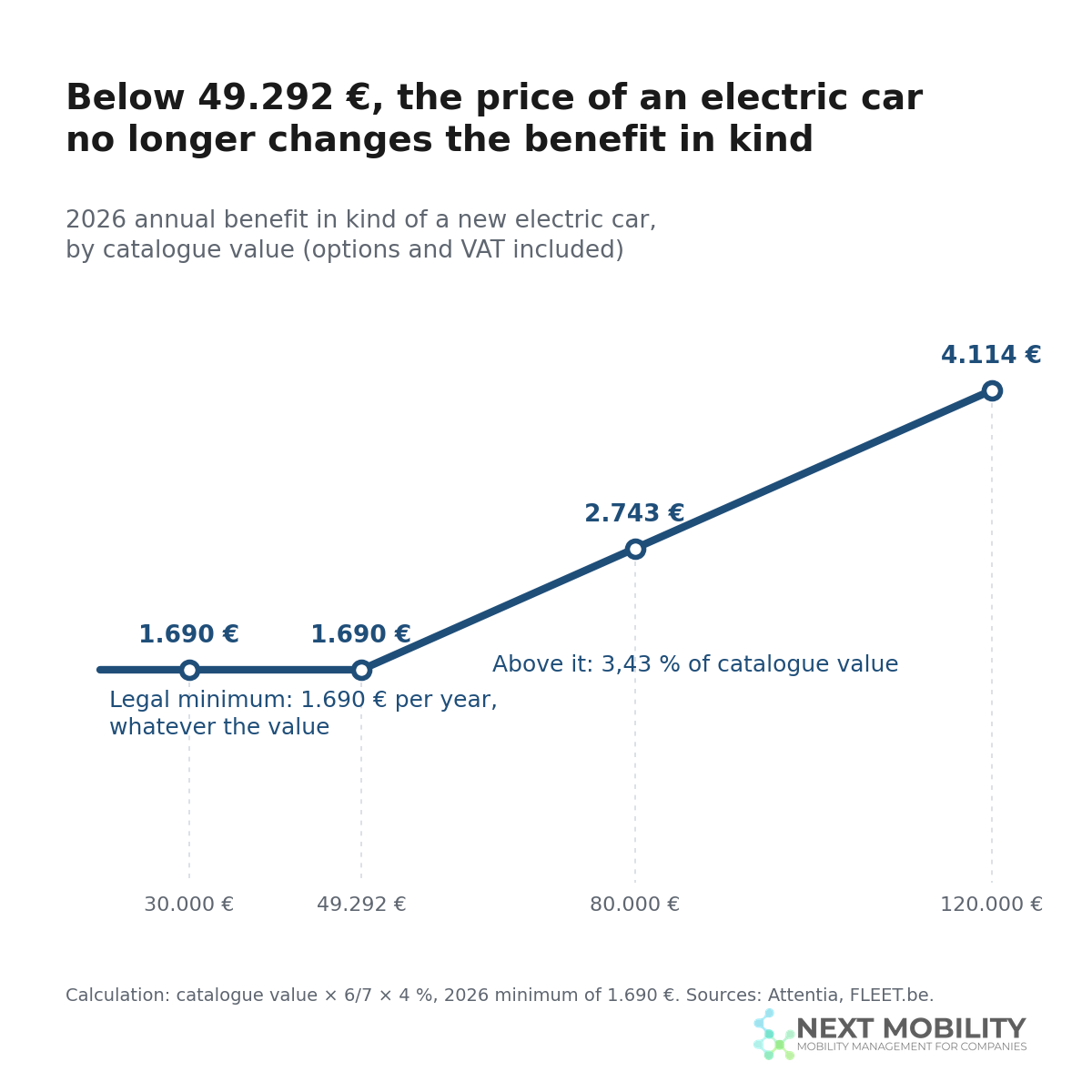
In 2026, the BIK cannot be lower than 1.690 € per year (1.650 € in 2025).
For a new electric car, this minimum is reached when catalogue value × 6/7 × 4 % equals 1.690 €, that is:
1.690 / (6/7 × 4 %) = 49.291,67 €
Below 49.292 € of catalogue value, options and VAT included, every new electric car gives exactly the same BIK.
| Catalogue value of a new electric car | Annual BIK 2026 | Tax on the BIK at a 50 % marginal rate |
|---|---|---|
| 30.000 € | 1.690 € (minimum) | 845 € |
| 40.000 € | 1.690 € (minimum) | 845 € |
| 49.292 € | 1.690 € (threshold) | 845 € |
| 60.000 € | 2.057 € | 1.029 € |
| 70.000 € | 2.400 € | 1.200 € |
| 80.000 € | 2.743 € | 1.371 € |
| 100.000 € | 3.429 € | 1.714 € |
| 120.000 € | 4.114 € | 2.057 € |
The formula is the same for a company director with a company car. This is often where catalogue values of 80.000 to 120.000 € are found: even there, the BIK of an electric car stays in the range of 3.000 to 4.000 € per year.
What you get in each price band. Two or three electric cars per 10.000 € band, with at least one SUV per band and a seven-seater wherever one exists, giving priority to the most registered models. Catalogue value without options and TCO taken from the DirectLease configurator on 28/09/2026 (60 months, 25.000 km per year, 65 % non-recoverable VAT, no fleet discount):
| Catalogue value band | Model and version | Type | Seats | Catalogue value | Monthly TCO | Annual BIK 2026 |
|---|---|---|---|---|---|---|
| Under 30.000 € | Renault 5 E-Tech 37 kWh Five ¹ | City car | 5 | 24.900 € | 670 € | 1.690 € (minimum) |
| Leapmotor B10 Life Pro ¹ | SUV | 5 | 29.900 € | 769 € | 1.690 € (minimum) | |
| 30.000 to 40.000 € | Tesla Model 3 RWD ² | Saloon | 5 | 35.990 € | 844 € | 1.690 € (minimum) |
| Kia EV3 58,3 kWh Business | SUV | 5 | 37.990 € | 769 € | 1.690 € (minimum) | |
| Tesla Model Y RWD ² | SUV | 5 | 39.990 € | 929 € | 1.690 € (minimum) | |
| 40.000 to 50.000 € | Skoda Elroq 60 Selection | SUV | 5 | 40.930 € | 851 € | 1.690 € (minimum) |
| XPeng G6 69 kWh ² | SUV | 5 | 41.490 € | 987 € | 1.690 € (minimum) | |
| Volkswagen ID.4 Pure | SUV | 5 | 41.610 € | 855 € | 1.690 € (minimum) | |
| 50.000 to 60.000 € | Skoda Enyaq 60 Selection | SUV | 5 | 50.445 € | 887 € | 1.730 € |
| BMW iX1 eDrive20 ² | SUV | 5 | 51.200 € | 1.024 € | 1.755 € | |
| Peugeot E-5008 213 Allure Plus | SUV | 7 | 53.710 € | 926 € | 1.841 € | |
| 60.000 to 70.000 € | BMW iX3 40 | SUV | 5 | 61.950 € | 1.256 € | 2.124 € |
| Kia EV9 76,1 kWh Business | SUV | 7 | 62.590 € | 1.169 € | 2.146 € | |
| Audi Q6 e-tron 185 kW ² | SUV | 5 | 65.050 € | 1.192 € | 2.230 € | |
| 70.000 to 80.000 € | Hyundai Ioniq 9 110 kWh Core | SUV | 7 | 71.995 € | 1.216 € | 2.468 € |
| BMW i5 Touring eDrive40 | Estate | 5 | 76.700 € | 1.467 € | 2.630 € | |
| Polestar 3 92 kWh | SUV | 5 | 78.900 € | 1.446 € | 2.705 € | |
| 80.000 to 90.000 € | Volvo EX90 Single Motor Core | SUV | 7 | 84.490 € | 1.678 € | 2.897 € |
| Porsche Macan | SUV | 5 | 84.500 € | 1.739 € | 2.897 € | |
| BMW iX xDrive45 | SUV | 5 | 85.850 € | 1.676 € | 2.943 € | |
| 90.000 to 100.000 € | Porsche Macan 4S | SUV | 5 | 95.300 € | 1.943 € | 3.267 € |
| Kia EV9 99,8 kWh GT AWD | SUV | 7 | 95.790 € | 1.742 € | 3.284 € | |
| Audi SQ6 e-tron | SUV | 5 | 96.500 € | 1.746 € | 3.309 € | |
| 100.000 to 120.000 € | Volvo EX90 Twin Motor Ultra | SUV | 7 | 101.990 € | 1.998 € | 3.497 € |
| BMW iX5 60 xDrive | SUV | 5 | 102.500 € | 2.159 € | 3.514 € | |
| BMW iX xDrive60 | SUV | 5 | 103.050 € | 1.962 € | 3.533 € | |
| Over 120.000 € | Mercedes EQS SUV 450+ AMG Line | SUV | 5 | 124.025 € | 2.411 € | 4.252 € |
| Mercedes EQS SUV 580 4MATIC AMG Line | SUV | 7 | 176.055 € | 3.332 € | 6.036 € |
¹ Among the electric cars most registered by private buyers in the first half of 2026. ² Among the five most registered electric cars in Belgium in the first half of 2026, all buyers combined (Febiac figures).
Four takeaways from this table.
- Up to 49.292 €, the TCO varies, the BIK does not. Monthly TCO ranges from 670 € to 987 €, a gap of 3.804 € per year, for exactly the same BIK of 1.690 €.
- Above it, TCO rises much faster than BIK. Between the cheapest seven-seater (926 € per month) and the high-end seven-seater at 101.990 € (1.998 € per month), the TCO gap is 12.864 € per year. The BIK rises by 1.656 €, roughly 828 € of tax at a 50 % marginal rate: 15 times less.
- There is no electric seven-seater below 50.000 €, but the first seven-seater in the table has a TCO in the same range as the most registered compact SUVs. Size and cost do not always go together.
- These are base prices. Options add to the catalogue value and to the lease, and a configured car often lands one band higher than its entry version. The models are listed to illustrate each band, with no judgement on their suitability for a fleet, and a public configurator TCO does not include fleet discounts.
The threshold rises with the age of the car. The age coefficient reduces the value taken into account, so an older car reaches the minimum at a higher catalogue value:
| Age of the vehicle | Coefficient | Catalogue value threshold in 2026 |
|---|---|---|
| 0 to 12 months | 100 % | 49.292 € |
| 13 to 24 months | 94 % | 52.438 € |
| 25 to 36 months | 88 % | 56.013 € |
| 37 to 48 months | 82 % | 60.112 € |
| 49 to 60 months | 76 % | 64.857 € |
| Over 60 months | 70 % | 70.417 € |
An electric car with a catalogue value of 55.000 € is therefore above the threshold in its first year, and at the minimum from its third year.
The other two car-related charges make no more difference. The CO2 solidarity contribution paid by the employer is at the legal minimum for any zero-emission car: 42,34 € per month in 2026 for a vehicle ordered since 1 July 2023. The road vignette announced by the three Regions for 1 May 2027 provides for 90 € per year for any electric vehicle, the lowest rate in the grid. Its details have not yet been finalised.
3. Above the threshold: a signal that exists, but stays weak
Many electric company cars, once configured, exceed 49.292 €. For them, the BIK becomes proportional to price again. But how much does the employee actually feel it?
A real example: the Skoda Enyaq, Selection trim, in the 60 version (50.445 €) and the 85 version (58.180 €). Both are above the threshold.
- Catalogue value gap: 7.735 €.
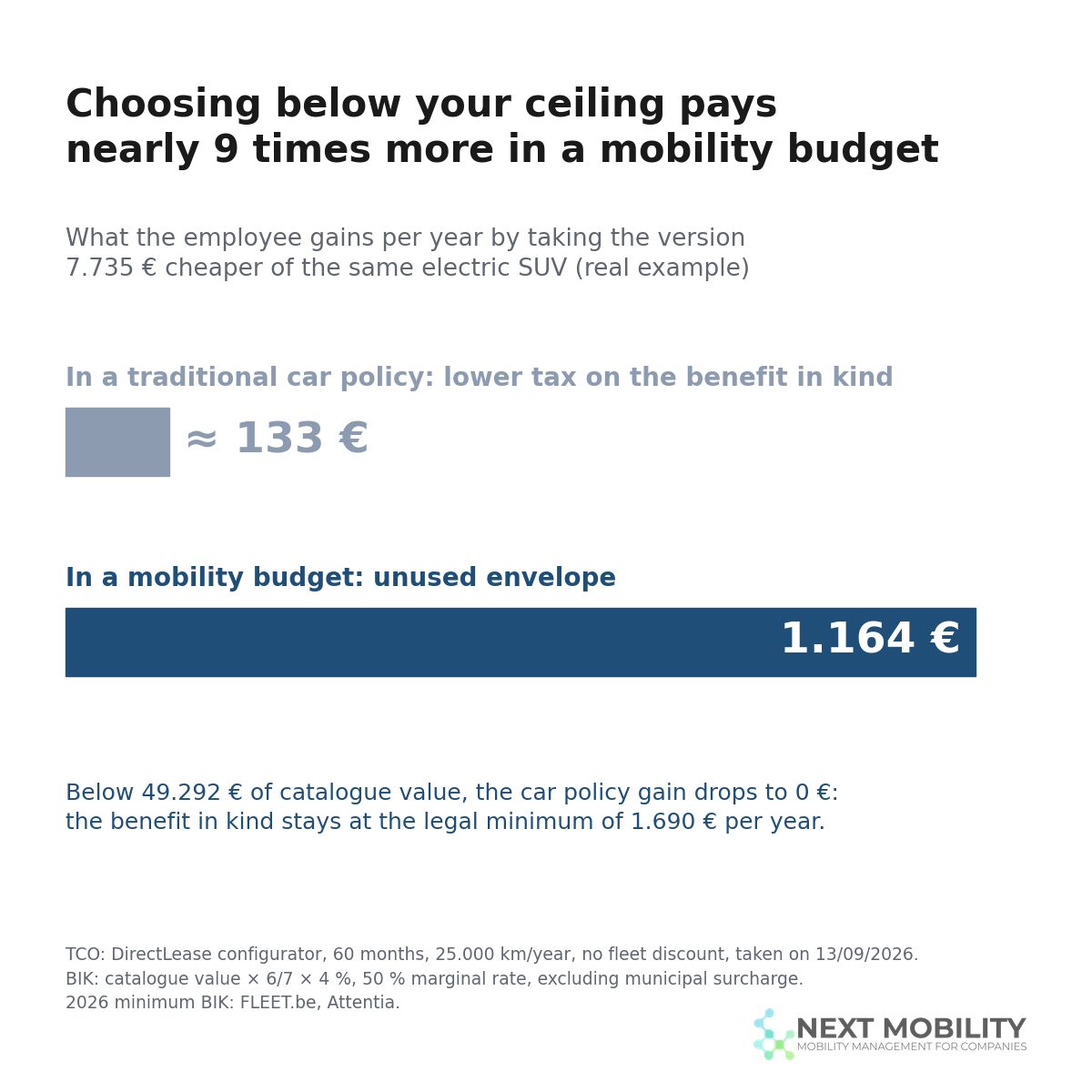
- Total cost of ownership (TCO) gap: 887 € versus 984 € per month, or 97 € per month, 1.164 € per year (DirectLease configurator, taken on 13/09/2026, 60 months, 25.000 km per year, 65 % non-recoverable VAT, no fleet discount).
- BIK gap: 7.735 × 6/7 × 4 % = 265 € per year.
- Tax gap for the employee: at a 50 % marginal rate, excluding municipal surcharge, roughly 133 € per year.
An employee who chooses the cheaper version therefore gains roughly 133 € per year. The 1.164 € gap benefits the employer entirely. And had both versions been below the threshold, the employee’s gain would have been 0 €.
Two words of caution. A public configurator does not include fleet discounts, which shift every figure. And the total cost of ownership does not follow catalogue value proportionally: the lessor factors in expected resale value and maintenance, which can narrow or widen the gap from one model to another. That is why the example compares two versions of the same model, in the same trim.
A word on TCO: TCO1, TCO2, TCO3
The industry uses three levels of TCO, and it is worth knowing which one is being discussed.
- TCO1: the running cost of the vehicle. Lease, road tax, maintenance, tyres, insurance, replacement vehicle, non-recoverable VAT, CO2 solidarity contribution, energy, and possibly the charging point.
- TCO2: TCO1 plus the corporate income tax due on the non-deductible share of the costs. It is the most complete reference for comparing powertrains, and TCO2 is the basis for calculating the envelope of a mobility budget.
- TCO3: TCO2 minus the tax saving generated by deductible costs. It is lower than TCO2, and it is often the one lessors put forward.
In our example, the choice of level does not change the conclusion. Both versions are electric, so 100 % deductible and subject to the same minimum CO2 contribution: their gap is practically the same in TCO1 and TCO2. At the standard corporate income tax rate of 25 %, the TCO3 gap would be about 873 € per year, still 6,6 times the employee’s tax gap.
For an electric car, which is 100 % deductible, TCO2 is therefore practically equal to TCO1: the TCO figures in this article give a good order of magnitude of the corresponding mobility budget envelope.
The distinction becomes decisive as soon as an electric car is compared with a combustion or plug-in hybrid car, which is no longer deductible: that is what the next section shows.
4. What about a plug-in hybrid or a petrol car?
The same formula applies, but the CO2 percentage is no longer locked at 4 %. In 2026 it starts from 5,5 % for a reference emission of 70 g CO2/km for petrol and 58 g for diesel, and moves by 0,1 point per gram, between 4 % and 18 %.
Three versions of the same SUV, same trim (DirectLease configurator, taken on 13/09/2026, 60 months, 25.000 km per year):
| Skoda Kodiaq, Selection trim | Type-approved CO2 | Catalogue value | CO2 percentage | Annual BIK 2026 | Monthly TCO | Deductibility |
|---|---|---|---|---|---|---|
| 1.5 TSI petrol mild hybrid | 135 g | 46.545 € | 12,0 % | 4.787 € | 1.511 € | 0 % |
| 2.0 TDI diesel | 138 g | 49.545 € | 13,5 % | 5.733 € | 1.663 € | 0 % |
| 1.5 TSI plug-in hybrid | 35 g | 51.945 € | 4 % (minimum) | 1.781 € | 1.278 € | 0 % |
| For comparison: Skoda Peaq 63 kWh, electric | 0 g | 49.490 € | 4 % | 1.697 € | 994 € | 100 % |
Two findings.
For a combustion car, the BIK becomes a real signal again. An employee who takes the diesel pays a BIK more than three times that of the electric car at the same price. Here, taxation does the job it was calibrated for.
The plug-in hybrid is the case where the employee sees nothing and the employer pays for everything. Thanks to its 35 type-approved grams, its BIK sits at the 4 % floor, on a par with an electric car. But it is no longer deductible, and its TCO is 284 € per month higher than that of the comparable electric car. And that TCO is itself a floor: it relies on type-approved consumption, whereas the real-world emissions of plug-in hybrids measured by the European Environment Agency in 2024 averaged 145 g CO2/km, against 24 g type-approved.
5. Vans follow an entirely different logic
Everything above applies to passenger cars. Light commercial vehicles have their own regime, provided they meet the tax definition of a van.
What the tax authorities call a van
Since 1 January 2006, article 4 of the Code of taxes assimilated to income taxes has defined the van: a vehicle designed for the carriage of goods, with a maximum authorised mass of 3,5 tonnes, matching one of these four types.
| Type | Seats, excluding the driver | Condition |
|---|---|---|
| Single cab pick-up | 2 at most | Open load bed |
| Double cab pick-up | 6 at most | Open load bed |
| Single cab panel van | 2 at most | Enclosed load space, separated from the cabin, at least 50 % of the wheelbase in length (measured 20 cm above the floor), fixed horizontal floor with no anchor points for extra seats |
| Double cab panel van | 6 at most | Same conditions, with a load space fully enclosed behind the last row of seats |
A double cab pick-up or panel van that meets these conditions is therefore indeed a van. Conversely, a vehicle registered as a commercial vehicle that matches none of these four types is treated as a car for tax purposes, and follows all the rules in the previous sections, catalogue value formula included. The 50 % of wheelbase criterion was introduced to stop passenger vehicles being registered as vans.
No private use, no benefit in kind
The benefit in kind question only arises where there is private use. A van used solely for business purposes, with no commuting, generates no benefit in kind and no CO2 solidarity contribution. The employer has every interest in being able to demonstrate this, for instance through a ban on private use written into its policy.
Where there is private use
- The benefit in kind is assessed at its real value, not with the flat-rate formula for cars: the actual costs of the vehicle (depreciation, insurance, maintenance, fuel or electricity) pro rata to private kilometres. For this calculation, commuting counts as private use.
- The CO2 solidarity contribution follows a different rule: the NSSO does not treat commuting as private use for this contribution. A van used only for commuting is therefore not subject to it; it becomes due as soon as there is private use beyond commuting.
A van used only for commuting can therefore generate a benefit in kind without any CO2 contribution.
Deductibility
Van costs remain 100 % deductible in 2026, even with a combustion engine, whereas a combustion passenger car ordered today no longer is.
For a mixed fleet, this means that a single allocation policy produces two benefits in kind calculated in completely different ways. We will cover this in detail in our article on choosing and fitting out vans.
6. What this means for a grid of job categories
If taxation passes almost none of the vehicle’s cost on to the employee, the only signal that reaches them is the one the employer decides to send. Two scenarios.
In a traditional car policy, the category sets a ceiling. A cheaper car benefits the employer, unless the policy provides a bonus for choosing below the ceiling. Without that bonus, choosing below the ceiling only brings the employee the tax difference on the BIK, roughly 133 € per year in our example, and nothing at all below the threshold. The employee therefore has almost no financial reason to choose below their ceiling.
In a mobility budget, the cost of the pillar 1 car is deducted from the envelope granted by the employer. In our example, the 1.164 € per year that the cheaper version does not use up stays with the employee:
- in pillar 2, exempt from tax and social contributions if spent on sustainable mobility (public transport, bicycles, shared mobility, housing costs within 10 km of the workplace);
- in pillar 3, paid out in cash after a special contribution of 38,07 %, roughly 721 €.
On top of that come the 133 € of lower tax on the BIK, since the pillar 1 car remains a company car subject to the same calculation.
For the employer, the cost remains the envelope it has set. The difference lies in what the employee sees, and therefore in what they choose.
One condition for this to work: the grid of job categories must be expressed in total cost of ownership (TCO), preferably TCO2, the basis of the mobility budget, and not in catalogue value or lease price alone. A grid in catalogue value says nothing about actual cost (public configurators show cars that are cheaper to buy and more expensive to run). A grid based on lease price alone leaves out energy, insurance and non-recoverable VAT. In both cases, the 1.164 € gap is visible nowhere.
Frequently asked questions
Does the minimum BIK also apply to a used car?
Yes. The 1.690 € minimum applies whatever the age of the vehicle. That is precisely why the catalogue value threshold rises with age (see the table in section 2).
Do options count in the catalogue value?
Yes, all options chosen, as well as the VAT actually paid. Discounts and rebates are not deducted.
Does a personal contribution from the employee reduce the BIK?
Yes, the employee’s personal contribution to the cost of the car is deducted from the BIK.
Is the BIK of a pillar 1 mobility budget car calculated differently?
No. The pillar 1 car is a company car; its BIK follows the same formula and the same minimum.
Is a double cab pick-up or panel van a van for tax purposes?
Yes, if it meets the conditions of article 4 of the Code of taxes assimilated to income taxes: at most 6 seats in addition to the driver and, for a panel van, a fully enclosed load space of at least 50 % of the wheelbase. Used solely for business purposes, it generates no benefit in kind.
Will the 1.690 € amount stay the same in 2027?
No, it is indexed every year. We will update this article as soon as the 2027 amount is published.
Our takeaway
Company car taxation was calibrated on CO2, and on that front it has achieved its goal. On the choice of vehicle within a category, it passes almost nothing on to the employee: 133 € per year for close to 8.000 € of catalogue value difference in our example, and nothing at all below 49.292 €.
If you want your employees to choose as sensibly as possible, the lever is not taxation. It lies in how your grid is built and in what your policy makes visible and recoverable for the person choosing.
If you would like to see what this means for your job categories, get in touch.
Sources
- 2026 BIK, minimum and formula: Attentia, 19/12/2025 · FLEET.be
- Definition of catalogue value (options, VAT actually paid, no discounts): Securex, updated 07/09/2026
- Age coefficients: D’Ieteren Mobility Solutions, April 2026
- Personal contribution deducted from the BIK, formula, share of electric cars among new company cars (81,59 % in Q1 2026, 10,54 % in Q1 2022): NSSO (ONSS/RSZ), monitoring of the greening of the company car fleet, first quarter 2026
- 2026 CO2 solidarity contribution: Securex
- Road vignette: RTBF
- Vans, BIK at real value and commuting: Moore, 25/03/2021 · Athlon, 07/01/2026
- Vans, CO2 contribution and commuting (NSSO position): Lexgo
- Tax definition of a van (four types, 50 % of wheelbase, in force since 1 January 2006): article 4, §§ 2 and 3, of the Code of taxes assimilated to income taxes, introduced by the programme law of 27 December 2005; purpose and scope confirmed by the Finance Minister in reply to Senate written question no. 4-121 (07/02/2008)
- 100 % deductibility of vans: Athlon, 07/01/2026
- TCO, BIK and deductibility of the examples (Skoda Enyaq, Peaq, Kodiaq): DirectLease configurator, taken on 13/09/2026, 60 months, 25.000 km per year, no discount
- Catalogue value, seats and TCO in the price band table (28 versions): DirectLease configurator, taken on 28/09/2026, price without options, 60 months, 25.000 km per year, 65 % non-recoverable VAT, no discount
- Most registered models in the first half of 2026: Febiac figures, La Libre, 24/08/2026
- TCO1, TCO2, TCO3: FLEET.be, 13/02/2023
- 2026 reference emissions (70 g petrol, 58 g diesel) and CO2 percentage: Attentia, 19/12/2025
- Real-world emissions of plug-in hybrids (145 g against 24 g type-approved, 2024): European Environment Agency, reported by Transport & Environment on 07/09/2026
- Vans taxed on the real value of the benefit: Securex, updated 21/05/2026