

January 2027 is nine months away. By that date, every Belgian company with 50 or more employees that offers company cars will be required to offer the mobility budget as an alternative. In January 2028, companies with 15 or more employees will follow.
The legal framework is clear. Putting it into practice is far less straightforward. And that’s where time works against you.
1. Implementation Takes 4 to 6 Months
Setting up a mobility budget is more than ticking a regulatory checkbox. It’s a cross-functional project that involves HR, finance, fleet management, and internal communications.
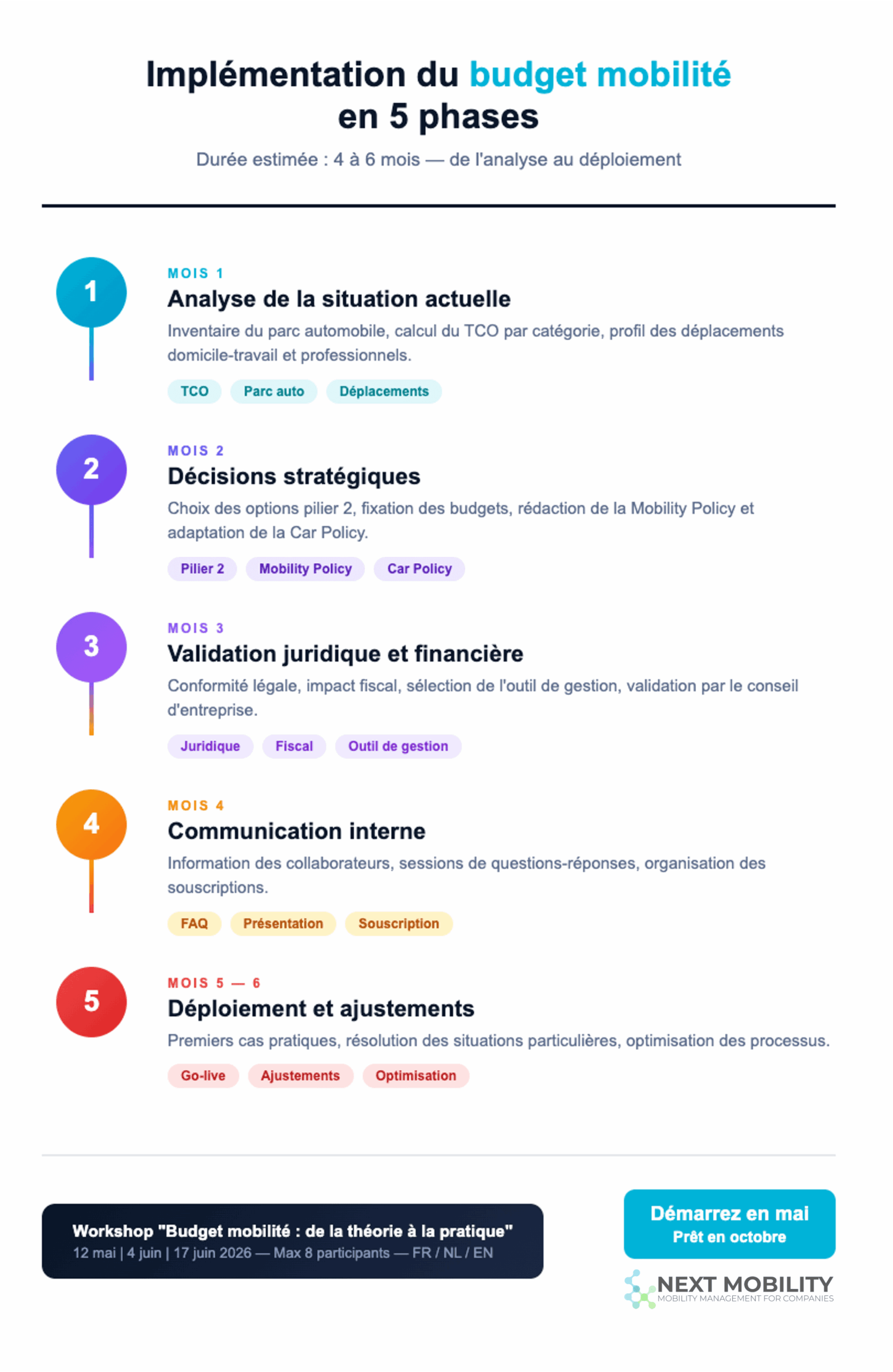
The typical implementation journey:
Phase 1 (month 1): analysis of the current situation — how many company cars, what TCO per category, what commuting profiles, what are the business travel needs, etc.
Phase 2 (month 2): strategic decisions — which pillar 2 options to activate, how to set budgets, drafting the mobility policy and adapting the car policy if necessary.
Phase 3 (month 3): legal and financial validation — legal compliance, tax impact, selection of the management tool if necessary, approval by the works council and if necessary consultation of the union delegation.
Phase 4 (month 4): internal communication — informing employees, answering questions, organising enrolments.
Phase 5 (months 5-6): deployment and adjustments — first practical cases, handling special situations, optimisation.
If you start in May 2026, you’ll be ready by October. If you start in September, you’ll be behind schedule.
2. The Operational Complexity Is Underestimated
The Acerta survey from February 2026 reveals that 72% of Belgian companies cite a lack of clarity as the main barrier to adopting the mobility budget. And only 4.51% of companies currently offer one.
It’s not willingness that’s lacking. It’s a practical roadmap.
A few examples of questions every company must resolve before rolling out the mobility budget:
Which pillar 2 options to activate? A company bicycle, a Belgian Rail (SNCB/NMBS) subscription, an electric scooter, car sharing, housing costs? Activating everything at once creates complexity. Too few options frustrates employees. The decision depends on the company’s location, employee profiles, and administrative capacity.
How to handle business travel? An employee who gives up their car and opts for the mobility budget must still be able to carry out their assignments. For profiles with fewer than 2,000 professional kilometres per year, this is feasible without a car. Beyond 5,000 km, a car likely remains necessary. In between, it’s case by case.
How to communicate with employees? The mobility budget is a cultural shift, not just an administrative one. Poor communication breeds distrust. Well-executed communication builds buy-in.
3. TCO Is the Starting Point Everyone Forgets
The mobility budget is calculated based on the Total Cost of Ownership (TCO) of the company car the employee gives up. This is the foundation of the entire system.
Yet in the majority of SMEs I work with, the TCO is not under control. Companies know their monthly leasing rate but not the fully integrated cost (insurance, fuel, registration tax, CO₂ solidarity contribution, maintenance, tyres).
Without a controlled TCO, it’s impossible to set budgets per category. Without correct budgets, it’s impossible to build a credible Mobility Policy. And without a Mobility Policy, it’s impossible to communicate clearly with employees.
4. The Mobility Budget Is an Employer Attractiveness Lever
Beyond the legal obligation, the mobility budget is a differentiation tool for companies recruiting in a tight labour market.
An employee who can choose between an electric car, a company bicycle, a train subscription, or a combination of the three feels treated like an adult. It signals a modern and flexible employer.
Companies that implemented the mobility budget early report a positive effect on retention and recruitment, particularly among urban profiles and young graduates who don’t necessarily want a car.
5. Early Implementers Will Have an Advantage
In 2027, when the obligation takes effect, all companies with 50+ employees will find themselves in the same situation. Those that have already had an operational mobility budget for several months will have an edge: well-tested processes, informed employees, and adjustments already made.
Latecomers will have to do everything in a rush, with the risk of errors, frustrations, and non-compliance.
What Now?
If your company offers company cars and hasn’t yet started preparing for the mobility budget, the optimal window for action is now — not September.
Workshop “Mobility Budget: From Theory to Practice”
I organise practical workshops for HR, finance, and fleet management teams that want to implement the mobility budget in a structured and confident manner.
In a full day (complete formula) or half day (express formula), you leave with all the tools you need:
- TCO under control: understand the “budget in” and set budgets per category
- Customisable Mobility Policy: complete and compliant template
- Communication kit: employee presentation, 24-question FAQ, template emails
- Business travel decision grid: objective assessment per profile
- Pre-enrolment questionnaire: structure each request
- 6-phase implementation checklist
- Selection of the mobility budget management tool if necessary
Maximum 8 participants per session. Real-life case studies from Belgian companies. Workshop available in French, Dutch, or English.
Upcoming sessions: Tuesday 12 May | Thursday 4 June | Wednesday 17 June 2026
Contact me to reserve your spot: nicolas@nextmobility.be
Sources
- Law of 17 March 2019 on the Mobility Budget (coordinated)
- Law of 25 November 2021 Organising the Tax Green Transition of Mobility
- Acerta Study, February 2026 — mobility budget adoption in Belgium
- FPS Mobility — lebudgetmobilite.be
- Field Data Next Mobility (workshops and client implementations)