

The company mobility budget is experiencing real growth in Belgium, especially as it gradually becomes (or should become as it is not yet confirmed) mandatory from 2026 onwards. For companies looking to implement a mobility budget and for employees wishing to optimize their commuting arrangements, understanding which vehicles can be financed is essential. Today, we’re focusing on a still little-known but promising category: intermediate vehicles, also known as motorized quadricycles.
The Belgian Mobility Budget: Legal Framework Recap
Before diving into the details, let’s briefly review how the mobility budget in Belgium works. This system, established in 2019 and strengthened by the law of November 25, 2021 on the fiscal and social greening of mobility, allows employees entitled to a company car to exchange it for a flexible annual budget.
The Three Pillars of the Mobility Budget
The system is based on three pillars that employees can combine according to their needs:
Pillar 1 – Environmentally Friendly Company Car
Employees can opt for a less polluting vehicle. Note that from January 1, 2026, only 100% electric cars (with zero CO2 emissions) will be accepted in this pillar. This measure is part of the internal mobility policy aimed at reducing the carbon footprint of company fleets.
Pillar 2 – Sustainable Transport and Housing Costs
This is the pillar of sustainable corporate mobility par excellence. It encompasses a broad range of solutions: public transport, company bikes, electric scooters, carpooling, shared mobility, and even part of rent or mortgage under certain conditions (housing located within 10 km of the workplace or remote work at least 60% of the time). Employers are required to offer at least one option in this pillar.
Pillar 3 – Balance Paid in Cash
Any unused amount can be converted to cash but is subject to a special contribution of 38.07%, making it less attractive from a tax perspective.
Amounts and Conditions
For 2025, the mobility budget is framed by a minimum of €3,164 and a maximum of €16,875 per year, without exceeding 20% of the employee’s total gross remuneration. This budget is calculated based on the TCO (Total Cost of Ownership) of the company car returned or to which the employee is entitled.
What is an Intermediate Vehicle?
Intermediate vehicles represent a new generation of urban mobility solutions, positioned between motorized two-wheelers and traditional cars. These are motorized quadricycles that serve as a smart alternative for active corporate mobility, particularly suited for urban and suburban journeys.
These vehicles are increasingly attracting companies as part of a company travel plan or sustainable fleet managementstrategy. They offer several advantages: compactness, low operating costs, significant carbon footprint reduction, and great maneuverability in urban settings.
European Categories: Understanding the L Classification
At the European level, regulations classify light motorized vehicles into several categories designated by the letter L, followed by a number and additional letter. This classification, defined by Regulation (EU) No. 168/2013, determines the technical characteristics, safety standards, and conditions of use for these vehicles.
L1e: Two-Wheeled Mopeds
These are classic mopeds, limited to 45 km/h maximum, with an engine displacement not exceeding 50 cc³ for combustion engines or a maximum power of 4 kW for electric motors. They require the AM license in Belgium.
L2e: Low-Speed Motor Tricycles
Three-wheeled vehicles, also limited to 45 km/h and with the same technical characteristics as L1e. They are often used for utility applications in urban areas.
L3e: Two-Wheeled Motorcycles
This category includes motorcycles over 50 cc³ or exceeding 45 km/h. It’s divided into subcategories (L3e-A1, L3e-A2, L3e-A3) according to power and requires an A or A2 license.
L4e: Motorcycles with Sidecar
Variant of L3e equipped with a sidecar, capable of carrying up to four people.
L5e: Motor Tricycles
Three-wheeled vehicles with a mass in running order not exceeding 1,000 kg. They are divided into:
- L5e-A: intended for passenger transport (up to 5 seats)
- L5e-B: designed for utility purposes (goods transport)
L6e: Light Motorized Quadricycles
These are the lightest four-wheeled vehicles in the classification. Their main characteristics:
- Maximum speed limited to 45 km/h
- Maximum unladen weight of 425 kg
- Maximum power of 4 kW (approximately 5.5 horsepower)
- Engine displacement limited to 50 cc³ for combustion engines
They are subdivided into:
- L6e-A: light road quads
- L6e-B: light quadrimobiles (including L6e-BP for passenger transport and L6e-BU for utility)
In Belgium, these vehicles require the AM license, except for people born before February 15, 1961. They carry a registration plate starting with the letter S.
L7e: Heavy Motorized Quadricycles
This is the category of particular interest for the mobility budget. L7e are quadricycles with superior performance:
- Maximum speed of up to 90 km/h
- Maximum unladen weight of 450 kg (passenger transport) or 600 kg (goods transport)
- Maximum power of 15 kW (approximately 20 horsepower)
This category includes several subcategories:
- L7e-A: heavy road quads (for maximum 2 people)
- L7e-B: heavy off-road quads
- L7e-C: heavy quadrimobiles, subdivided into L7e-CP (passenger transport) and L7e-CU (goods transport)
To drive an L7e in Belgium, a B license is required. These are vehicles perfectly suited for urban and suburban use, offering protection and comfort while remaining compact and economical.
Intermediate Vehicles in Pillar 2: Regulatory Interpretation
Now that we’ve established the framework, the crucial question for companies and employees is: which intermediate vehicles can be financed through the mobility budget?
Legal Framework: Circular 2022/C/20
Circular 2022/C/20 of February 15, 2022 on the fiscal greening of mobility provides important clarifications. In section 5.1, it indicates that from January 1, 2022, a new subcategory of electric mobility devices has been added to pillar 2 in the “soft mobility” category:
“motorized tricycles and quadricycles, as defined in the general regulation on road traffic police and use of public roads, with the understanding that these are only considered when they are electrically propelled and designed for passenger transport and, concerning quadricycles, equipped with a closed cabin.”
This wording is essential as it establishes three cumulative conditions for a quadricycle to be financed through the mobility budget:
- Electric propulsion: the vehicle must be electric (this requirement will be extended to all motorized vehicles in pillar 2 from January 1, 2026)
- Passenger transport: the vehicle must be designed to transport people
- Closed cabin: for quadricycles, a closed cabin is required
Belgian Highway Code Definition
The Belgian Highway Code (article R311-1) defines motorized quadricycles as:
“any motor vehicle with four wheels that does not meet the definition of a motorized mobility device or moped, whose mass in running order does not exceed 450 kg or 600 kg for vehicles used for goods transport, this mass being understood excluding batteries for electric vehicles.”
Our Interpretation: Which Categories are Eligible?
Based on these texts, here is my analysis as a corporate mobility consultant:
Electric L7e with closed cabin are eligible
These vehicles meet all conditions: they are electric, designed for passenger transport (subcategories L7e-A and L7e-CP), and have a closed cabin. Their maximum weight (450 kg excluding battery for passenger transport) is below the limit set by the Highway Code (450 kg or 600 kg depending on use).
Electric L6e with closed cabin should also be eligible
Although the circular mainly targets “motorized quadricycles” broadly, electric L6e-B equipped with a closed cabin (such as L6e-BP intended for passenger transport) respect the three stated conditions. Their unladen weight of maximum 425 kg remains within legal limits.
Electric tricycles (L5e) with closed cabin are eligible
The circular explicitly mentions “motorized tricycles and quadricycles.” Electric L5e-A tricycles (passenger transport) equipped with a closed cabin therefore fall within the scope of application.
Vehicles without closed cabin are not eligible
This condition effectively excludes open quads, even electric ones, as well as “buggy” type vehicles or convertible versions of certain models.
Practical Case: The Microlino in the Mobility Budget
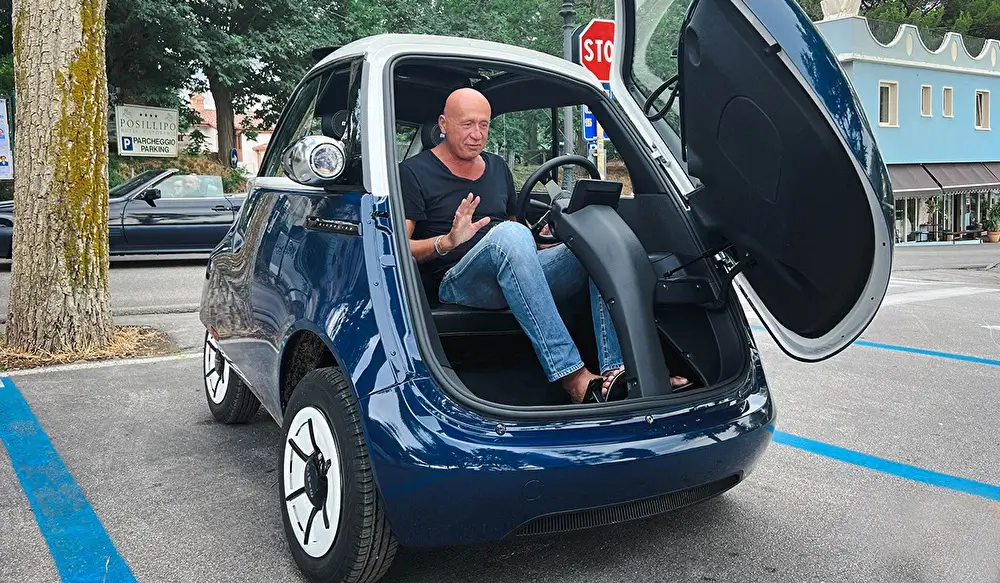
To concretely illustrate our point, let’s take the example of the Microlino, this charming electric quadricycle inspired by the 1950s Isetta, which is generating significant interest in Belgium.
Microlino Technical Specifications
The Microlino exists in two versions:
Microlino L7e (standard version)
- Category: L7e
- Power: 12.5 kW (approximately 17 hp)
- Maximum speed: 90 km/h
- Unladen weight: between 496 kg and 530 kg depending on battery (but excluding battery, the vehicle respects limits)
- Available batteries: 6 kWh, 10.5 kWh or 14 kWh
- Range: from 91 km to 230 km depending on battery
- Seats: 2 people
- Cabin: completely closed with self-supporting steel and aluminum body
- Price: from €17,990
Microlino Lite L6e
- Category: L6e
- Power: 4 kW (approximately 5.5 hp)
- Maximum speed: 45 km/h
- Unladen weight: less than 350 kg (excluding battery)
- Advertised range: 100 to 180 km
- License required: AM (or no license for people born before February 15, 1961)
Mobility Budget Eligibility
The Microlino L7e is eligible for pillar 2 of the mobility budget. It meets all conditions:
- ✅ 100% electric propulsion
- ✅ Designed for passenger transport (2 seats)
- ✅ Completely closed cabin with robust structure
- ✅ L7e category compliant with regulations
The Microlino Lite L6e should also be eligible, for the same reasons, although its speed limited to 45 km/h and reduced power make it suitable for more restricted use.
Benefits for Company and Employee
Integrating a Microlino into a company mobility budget presents several advantages:
For the employee:
- Solution 100% exempt from social contributions and taxes (pillar 2)
- Fun and friendly vehicle that stands out
- Very low operating costs (electric charging)
- Easy parking in the city (takes up one-third of a normal space)
- Mobility budget benefits fully exploited
For the company:
- Contribution to reducing corporate carbon footprint
- Innovative and committed image regarding sustainable corporate mobility
- Controlled TCO costs (no taxes in Flanders, minimum rates in Wallonia and Brussels)
- Soft mobility awareness tool for teams
- Differentiating mobility solutions for employees
Alternatives: Other Intermediate Vehicles on the Market
The Microlino is not the only intermediate vehicle available in Belgium. Other options deserve exploration as part of your sustainable fleet management strategy:
Kilow La Bagnole (L6e and L7e) – The French Favorite!
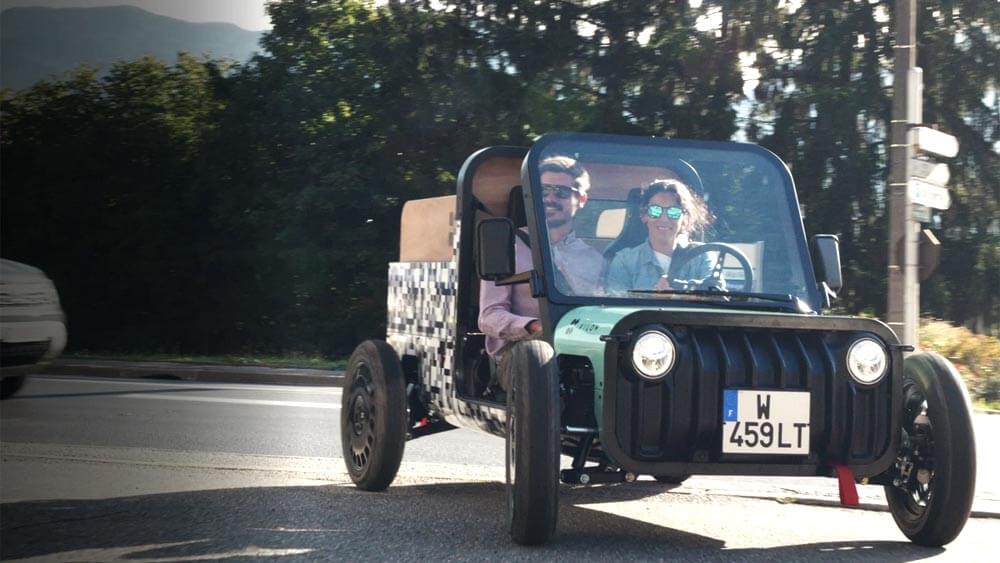
This is probably one of the most original and endearing intermediate vehicles on the market, even if it remains too little known. La Bagnole is manufactured in Haute-Savoie, in Thyez, by the Kilow brand of Groupe Savoy, specializing in simple and ecological electric mobility objects.
Design and Philosophy
La Bagnole breaks free from modern automobile conventions with its mini-buggy appearance that recalls both the original Jeep Willis and the Citroën Méhari. Its minimalist and fun design leaves no one indifferent. At only 2.82 m long with 39 cm ground clearance, it’s as comfortable in the city as on country roads.
Technical Specifications
La Bagnole exists in two versions compliant with European categories:
L6e Version (no license or AM license from age 14)
- Maximum speed: 45 km/h
- Power: 6 kW nominal (up to 15 kW peak)
- Battery: 6 kWh
- Range: approximately 70 km
- Weight: approximately 350-400 kg (depending on options)
- Price: from €10,800 (€9,900 with ecological bonus deducted)
L7e Version (B license required)
- Maximum speed: 80 km/h
- Power: 15 kW (20 hp)
- Battery: 12 kWh (two modules)
- Range: approximately 135 km
- Price: from €13,690 (€12,790 with bonus deducted)
Unique Assets
What makes La Bagnole particularly interesting for the company mobility budget:
- French manufacturing: 100% produced in Haute-Savoie with 80% of parts manufactured in Europe
- Closed cabin: eligible for pillar 2 of mobility budget (doors and roof available as options)
- Repairable batteries: major innovation developed with a Parisian startup, batteries can be opened and cells replaced, offering near-infinite lifespan
- Extreme modularity: with or without doors, with or without roof, choice of colors and screen printing, 650-liter rear bed customizable (refrigerated, secure, compartmentalized cell…)
- Payload capacity: 150 kg payload despite its featherweight
- Low-tech philosophy: no superfluous gadgets, interior with solid wood dashboard, minimalist gauge – the essentials for responsible mobility
- Fun: 0 to 45 km/h in 4 seconds, driving sensations close to go-kart
Versatile Use
La Bagnole allows you to do your shopping, organize a surf trip or mountain bike ride, deliver to customers, or go to your fields. It’s suitable for both individuals and professionals (urban deliveries, technical services, maintenance…).
The Downside
Like any new manufacturer, Kilow has experienced homologation delays. Now homologated and in production, delivery times remain approximately 12 months due to high demand and still limited production capacity. But for such a unique vehicle, manufactured in France with such attention to sustainability, the wait may be worth it!
Mobility Budget Eligibility
Both versions of La Bagnole (L6e and L7e) are eligible for pillar 2 of the mobility budget, provided you opt for the closed cabin (doors + roof). It’s a particularly interesting option for companies wishing to support French local production while offering an original vehicle to their employees.
Citroën Ami (L6e)
- Attractive price (from €7,990)
- Speed limited to 45 km/h
- Closed cabin
- Very compact (2.41 m long)
- Proven commercial success in Belgium
- Wide distribution network
Renault Twizy
- Pioneer of the segment (launched in 2012)
- Warning: basic version semi-open, therefore not eligible (full door version would be needed)
- L7e category in high-power version
- Production discontinued in 2023
Silence S04 (L7e)
- Spanish 100% electric quadricycle
- Closed cabin
- Practical removable battery
- Ideal for urban fleets
Other Models to Watch
The intermediate vehicle market is booming. Many manufacturers are currently developing models that could be eligible for the mobility budget. Watch for announcements of new electric L6e and L7e with closed cabins, particularly from French manufacturers betting on local production.
Mobility Budget and Intermediate Vehicles: A Winning Duo for Brussels and Belgium
Integrating intermediate vehicles into the company mobility budget represents a significant opportunity for Belgian companies, particularly those located in urban areas like Brussels, Antwerp, Ghent, or Liège.
Why This Duo is Winning?
Response to Urban Mobility Challenges
Belgian cities face growing challenges: congestion, pollution, lack of parking spaces. Intermediate vehicles offer a suitable response to these issues by combining the advantages of cars (protection, comfort) and two-wheelers (compactness, agility).
Supporting Fleet Greening
With the progressive obligation to switch to zero-emission vehicles, electric intermediate vehicles constitute a smart transition solution, especially for short trips that represent the majority of professional journeys.
Cost Optimization for Companies
The TCO of intermediate vehicles is significantly lower than that of traditional cars. Combined with the tax advantages of pillar 2 (total exemption), this represents substantial savings for companies.
Attractiveness for Talent
Offering innovative mobility options like intermediate vehicles can become a differentiation argument in recruiting and retaining talent, particularly among younger generations sensitive to environmental issues.
Brussels Corporate Mobility Solutions: Particularly Favorable Terrain
Brussels and its region present ideal characteristics for deploying corporate mobility solutions based on intermediate vehicles:
- High urban density
- Relatively short distances (majority of trips are less than 10 km)
- Proactive policy favoring sustainable mobility
- Increasingly strict Low Emission Zone (LEZ)
- Significant development of corporate charging infrastructure
2026 Mobility Budget: What Will Change
From January 1, 2026, several important developments will impact the use of intermediate vehicles in the mobility budget:
Generalized Obligation for Employers (not yet confirmed)
Any company that grants or plans to grant company cars must mandatorily offer the mobility budget to all eligible employees. This measure will considerably accelerate adoption of the system and create new opportunities for mobility solutions for employees. This has to be confirmed by a legal text which is not yet the case (at least today December the 2nd)
Tightening of Environmental Standards
- In pillar 1, only 100% electric cars will be accepted
- In pillar 2, all motorized vehicles (including soft mobility) must be electric
- This evolution further reinforces the attractiveness of electric intermediate vehicles like the Microlino
Administrative Simplification
The government is working to simplify procedures for implementing the mobility budget. Access conditions should be relaxed, making the system accessible to more companies, including SMEs.
Company Bike vs Company Car: Where do Intermediate Vehicles Fit?
The debate between company bike vs company car is well known. Intermediate vehicles position themselves as an interesting compromise:
Advantages over Bikes:
- Weather protection
- Ability to carry a passenger
- Superior range and speed
- Increased comfort
- Suitable for longer distances (up to 20-30 km)
Advantages over Cars:
- Reduced footprint (easy parking)
- Very low operating costs
- Minimal carbon footprint
- Urban maneuverability
- Innovative and ecological image
Intermediate vehicles can thus complement an active corporate mobility offering by covering needs that neither bikes nor traditional cars can optimally satisfy.
Towards MaaS for Belgian Companies Integrating Intermediate Vehicles
The future of corporate mobility in Belgium likely involves a MaaS (Mobility as a Service) approach integrating different transport solutions, including intermediate vehicles.
What is MaaS?
MaaS consists of offering integrated and flexible access to different modes of transport via a single platform. For companies, this means offering employees a “mobility account” allowing them to combine several solutions according to their needs:
- Electric company vehicle for long distances
- Intermediate vehicle for daily urban trips
- Public transport for certain journeys
- Company bike for short distances
- Company shared vehicle fleet as a complement
Intermediate Vehicles in a MaaS Strategy
Electric quadricycles like the Microlino naturally find their place in a MaaS offering:
- They can be made available in a company shared vehicle fleet
- They are easily bookable via an app
- Their low cost allows offering multiple units
- They respond to specific needs (urban trips for 2 people)
Practical Tips for Choosing an Intermediate Vehicle
If you’re considering integrating intermediate vehicles into your company mobility budget, here are some selection criteria:
Technical Criteria
- Real range: prioritize a range of at least 100 km in real use
- Charging time: verify compatibility with your infrastructure
- Closed cabin: essential for mobility budget eligibility
- Category: L7e for more versatility (90 km/h) or L6e for short trips (45 km/h)
- Number of seats: minimum 2 seats if you want to carry a passenger
Practical Criteria
- Availability: some models have significant delivery times
- Distribution network: prioritize brands with a network in Belgium
- After-sales service: crucial for fleet maintenance
- TCO cost: analyze total cost (acquisition, insurance, maintenance, energy)
Legal Criteria
- Homologation: verify that the vehicle is properly homologated L6e or L7e
- Electric propulsion: mandatory for mobility budget from 2026
- Insurance: compare specific offers for quadricycles
In Conclusion: An Opportunity to Seize
Intermediate vehicles, and notably electric quadricycles in L6e and L7e categories with closed cabins, constitute an option to seriously consider within the company mobility budget in Belgium.
Their eligibility for pillar 2, combined with their numerous advantages (compactness, low costs, sustainability), make them particularly relevant mobility solutions for employees, especially in urban areas. Models like the Microlino and La Bagnole demonstrate that it’s possible to combine driving pleasure, innovation, and environmental responsibility.
For CEOs, CFOs, HR managers, and facility managers who wish to implement the mobility budget or enrich their company travel plan, intermediate vehicles represent an additional piece in the puzzle of modern, flexible, and sustainable corporate mobility.
The progressive mobility budget obligation from 2026, coupled with the inevitable greening of fleets, makes this a particularly opportune time to explore these new forms of mobility. As a corporate mobility consultant, I can only encourage you to integrate this reflection into your overall sustainable corporate mobility strategy.
Don’t hesitate to contact us at NextMobility for personalized sustainable mobility coaching and discover how to optimize your internal mobility policy by integrating these innovative vehicles.
Article written by Next Mobility, your partner for sustainable corporate mobility in Belgium. We support Belgian companies in implementing their corporate mobility solutions in Brussels and throughout the country, with specialized expertise in mobility budget, fleet electrification, and corporate charging infrastructure.