

A clarification before we begin: I’m not anti-car. Cars have a role to play, and in many cases they remain the only realistic option. What I defend is reducing their use where alternatives exist, and more moderate usage when they’re genuinely necessary. The goal isn’t to eliminate cars—it’s to break the systematic dependency.
The Industry Pushes Back
You hear them more and more loudly. D’Ieteren, Renta, EV Belgium, VBO/FEB, Pluxee, and even STIB and SNCB—a series of automotive and mobility sector players are pushing back against housing costs in the mobility budget.
Their argument: 77% of mobility budget spending goes to housing costs. According to Denis Gorteman, CEO of D’Ieteren Auto, it’s “an aberration.” Stijn Blanckaert, Managing Director of Renta, proposes capping pillar 2 at €200/month. Ben Broeckx of Pluxee argues that only 30% of the budget actually serves mobility. Pieter Timmermans, CEO of VBO/FEB, claims that “the mobility budget should not be a disguised housing bonus.”
And they have reason to worry—for their business. Because with the generalization of the mobility budget (mandatory as of January 2027 for companies with more than 50 employees), that amount will increase. More importantly, workers will start thinking differently about their mobility spending. Not everyone will max out their car budget to the last euro available. Some will switch to a smaller, cheaper vehicle, or buy one privately and use it less. Others will combine housing with public transit passes without going full-time on a subscription. The mobility budget forces the kind of reflection that a free company car never encouraged.
That’s what worries the industry.
A Bit of History: Why Company Cars Exist in Belgium
To understand the debate, you need to understand the system that created it.
The company car in Belgium isn’t the result of a mobility policy. It’s the byproduct of a tax system. Belgium has one of Europe’s highest tax wedges: between gross and net salary, the gap is such that a €100 raise costs the employer roughly €250. Rather than reform tax policy on labor, employers and legislators found a loophole: the fringe benefit. The company car—lightly taxed, deductible for the employer, and perceived as “free” by the worker—became the go-to mechanism for salary compensation.
The numbers tell the story. In 2007, 7.4% of salaried workers had a company car. In 2025, that’s 15%—or 627,000 vehicles. The fleet grew 130% in 15 years, while the number of salaried employees rose only 16%. The cost to the state? Around €5 billion per year in lost tax revenue, according to the latest estimates from the SPF Mobility.
Irony of history: Belgium once had a thriving automotive industry—Renault in Vilvoorde (closed 1997), Opel in Antwerp (2010), Ford in Genk (2014), Audi in Brussels (2024). Back then, subsidizing cars had at least a local industrial logic: supporting local jobs. All those plants have closed. There’s virtually no automotive assembly left in Belgium. But the tax system? Still there.
The “Free” Car and Urban Sprawl: The Vicious Circle
The company car didn’t just cost the state money. It reshaped Belgium’s geography.
When a commute is fully covered—vehicle, fuel, maintenance, insurance, everything included—distance has no price. A worker in Brussels can settle in Wavre, Aalst, or Mechelen without paying a euro more. The result is the urban sprawl Belgium knows better than anyone in Europe: the famous Flemish “ribbon development” (lintbebouwing), Walloon housing tracts along national highways, residential suburbs ever more distant from employment hubs.
Researchers at KU Leuven and VUB have documented it: since the 1960s, periurbanization in Belgium has been enabled by the generalization of automobile mobility. The company car, with its fuel card, only accelerated the process. And the result is measurable: the average commute distance in Belgium today is 20.8 km (federal CDT survey 2024-2025). For those working in Brussels coming from another region, it’s 29.9 km.
We created a system where the free car pushes people to move away, making the car essential, which justifies keeping the car free. It’s a vicious circle—and it’s exactly what the mobility budget allows us to break.
Pillar 2 Is the Solution—Not the Problem
The objective of pillar 2 of the mobility budget is crystal clear in the law: to enable the worker to finance housing close to their workplace. Not speculative real estate investment. A geographic shift closer.
And data from the federal CDT survey 2024-2025 (1.78 million workers, 382,780 flows analyzed) shows it has real potential.
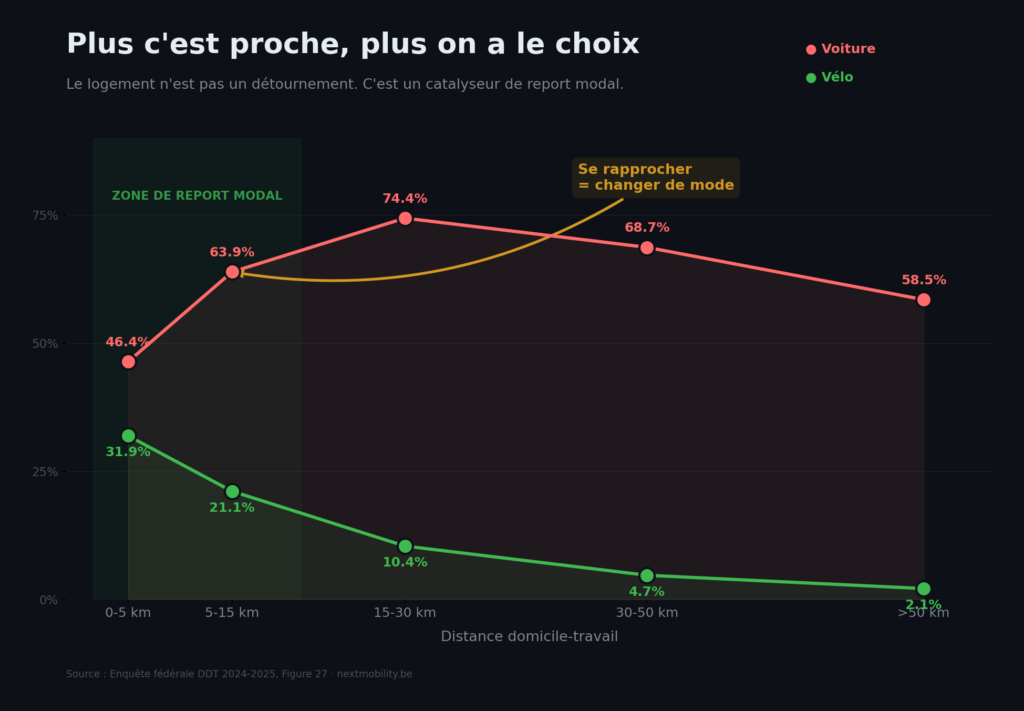
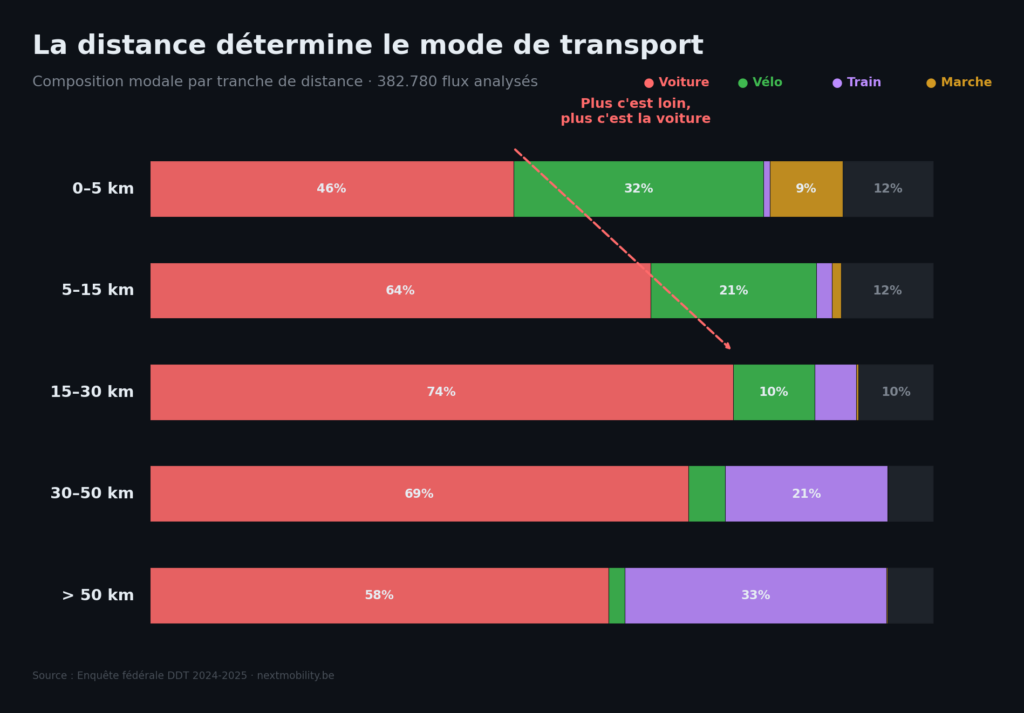
Distance determines the mode of transport. This is the most fundamental finding of the federal report (Figure 27):
For trips under 5 km: 46.4% by car, 31.9% by bike, 9.3% on foot. More than half of commuters use an alternative.
For trips 5 to 15 km: 63.9% by car, but still 21.1% by bike. With the rise of e-bikes, this is the range where modal shift has the most potential.
For trips 15 to 30 km: 74.4% by car. Biking drops to 10.4%. Beyond this distance, the car dominates.
The message is crystal clear: bringing someone closer to their workplace mechanically increases their transport alternatives.
And it’s not just theory. 26% of Belgians cite proximity to work as a criterion when choosing housing (Immoweb/Batibouw survey). People want to live closer—but prices prevent them. The mobility budget, via pillar 2, offers precisely a financial lever to make that proximity accessible. Pillar 2 is 100% exempt from social charges and taxes: every euro invested in housing is a net euro.
The Effect No One Mentions: The End of “It’s Free, So I’ll Drive”
There’s one aspect of pillar 2 that the debate almost systematically ignores. An employee who dedicates 100% of their mobility budget to housing costs no longer has a company car. No more fuel card. No more “free” leasing. They still need to get around—but they’ll do it far more thoughtfully.
When a car is no longer “free,” the reflex changes. You think before turning the key. You compare alternatives. You bike when it’s nice out, take the train when it’s direct, drive the car when it’s really necessary. That’s exactly the behavior all mobility policies try to encourage—and pillar 2 produces it mechanically, without constraint or awareness campaigns.
Why Companies Should Offer It—and Keep It
In my consulting work, the question “should we activate housing costs in pillar 2?” doesn’t really come up. The answer is always yes. Here’s why.
For the employee, it’s a concrete, immediate benefit: shorter commute, better quality of life, access to better-located housing thanks to a tax-free financial boost. It’s a powerful retention and recruitment argument, especially for younger profiles who don’t necessarily want a company car.
For the employer, it’s operationally straightforward. A single housing verification once per year. No vehicles sitting on parking lots or significant exit costs when an employee leaves. No claims management, tire costs, car policies, or spiraling TCO from abuse. Compared to fleet management, it’s incomparably simpler and less risky.
For HR and Fleet Management, pillar 2 reduces administrative burden and compensation package complexity. One employee on pillar 2 is one fewer employee in the fleet.
The Risk to Watch: Distant Housing Justified by Telework
Let’s be honest: there’s a real debate to be had around pillar 2. But it’s not the one the industry is pushing.
The real issue is using pillar 2 to finance housing more than 10 km from the workplace, justified by predominantly working from home. The legal framework allows it: the housing must be a maximum of 10 km from the workplace or must be the place where the worker works most often (per month).
That’s where the logic of the mobility budget inverts. Instead of reducing distance to encourage modal shift, we maintain large distance by reducing commute frequency. A worker living 40 km away and working from home 4 days a week certainly makes fewer trips, but each trip remains a solo car journey. And if telework policy changes—or if that worker changes employers—the distance is still there.
Humans are social beings. Regular in-person meetings—not necessarily daily—remain essential for team cohesion, creativity, and well-being. Telework is a complement, not a substitute for human connection. And it shouldn’t become a pretext for maintaining long-distance car dependency.
If the government wants to regulate pillar 2, this is where to act: tighten the distance condition and eliminate the telework exception. Not cap it at €200/month or remove the option entirely.
An Angle Nobody Raises: The Local Economic Impact
Here’s something the debate completely ignores.
When a worker uses their mobility budget for pillar 1 (vehicle), where does the money go? Into a car assembled in Germany, China, South Korea, or the Czech Republic. To an importer, a foreign manufacturer, a multinational supplier. The added value leaves Belgium.
When that same worker uses their mobility budget for pillar 2 (housing), where does the money go? Into rent paid to a Belgian landlord. Into a mortgage with a Belgian bank. Into renovations by local contractors—and potentially into insulation, a heat pump, solar panels, in short into the energy efficiency of Belgian buildings. Into the local economy, from the first euro to the last.
Admittedly, pillar 1 also generates activity in Belgium: maintenance, tires, insurance, charging stations. But these amounts remain marginal compared to the vehicle purchase price itself, which represents the bulk of the budget and leaves the country.
The irony is striking: investing in housing via pillar 2 often means renovating and making a building more energy-efficient. Investing in pillar 1, in current practice, too often means buying a bigger, heavier electric SUV than the last one. On the ground, I regularly see workers choosing BMW iX3s, Mercedes GLC, Audi Q6 e-tron, or BMW iX—2 to 2.5 tonnes, 20 to 25 kWh/100 km, systematically ordered with the largest battery when the standard would suffice in 90% of cases. One reduces energy consumption, the other increases it.
This isn’t an argument against pillar 1—electrification is necessary. But when representatives of foreign automotive industry ask to redirect the mobility budget toward buying vehicles… it’s worth remembering where the money ends up and what it produces.
Conclusion: Maintain Pillar 2 at Full Potential
The mobility budget is the first structural tool in Belgium that allows us to break the vicious circle of free car → moving away → car dependency. Pillar 2 is its most powerful—and most attacked—lever.
Eliminating it would strip the mobility budget of its most differentiating and simplest-to-manage asset. We’d revert to a vehicle-centered system, exactly what we’re trying to move past.
Capping it at €200/month, as Renta proposes, amounts to gutting it. In Brussels, Antwerp, or Ghent, €200 covers nothing. It’s a disguised elimination.
Better regulation, on the other hand, makes sense. The drift of telework as justification for distant housing is real. Eliminating the “50% telework” exception and keeping only the 10 km condition around the workplace would be a simple and coherent improvement.
Pillar 2:
- Reduces commute distance → activates modal shift
- Eliminates the “free” car → makes trips more thoughtful
- Simplifies operational management for employers
- Injects money into the local economy instead of foreign automotive industry
- Invests in energy renovation rather than ever-heavier SUVs
It’s not a diversion. It’s intelligent mobility policy. The data confirms it. Let’s maintain it.
Methodology and Sources
This analysis draws primarily on results published in the official report of the federal home-work commute survey 2024-2025 (SPF Mobility and Transport). The modal share figures by distance range use data from Figure 27 of the report (ranges 0-5, 5-15, 15-30, 30-50, >50 km). Average distances come from Table 7.
Privacy Note: The raw data from the origin-destination matrix provided by SPF is subject to confidentiality commitments and is not publicly distributed. Only the aggregated results and figures from the official report are cited in this article.
Sources:
- Federal home-work commute survey 2024-2025, SPF Mobility and Transport / FOD Mobiliteit en Vervoer, March 2026
- SPF Mobility (2025): 627,000 company cars, 15% of employees, +130% in 15 years
- Fiscal cost of company cars: €5 billion/year (RTBF / SPF Finance, 2025)
- Mbrella data: +45% pillar 1 between 2023 and 2025
- Positions D’Ieteren, EV Belgium, VBO/FEB, Renta, Pluxee: articles link2fleet.com (March 2026)
- Periurbanization and urban sprawl in Belgium: KU Leuven, VUB, MDPI Sustainability (2020)
- Immoweb/Batibouw survey on relocation intentions
- lebudgetmobilite.be
From mobility budgets to fleet electrification, I support companies from analysis to operational management.
📧 nicolas@nextmobility.be · 📱 +32 478 95 64 10 · 🌐 www.nextmobility.be