

“I can’t switch to electric.” That’s the phrase I hear most often in workshops with fleet managers and HR directors. Not as a question. As a statement.
Except that in the majority of cases, this statement doesn’t hold up when you look at the numbers. In 2026, with current infrastructure, available vehicles, and actual commute distances in Belgium, EV electro-incompatibility has become the exception — not the rule.
Here’s the data.
1. Real commute distances: the first misconception
The most reliable data on home-to-work commutes in Belgium comes from the Federal Home-to-Work Travel Survey conducted by FPS Mobility and Transport. This diagnostic, mandatory since 2005 for all employers with more than 100 people, covers 1.6 million workers across 9.731 establishments nationwide.
Average distance per trip : 21 km per commute, or 42 km round-trip (Federal Home-to-Work Travel Survey 2021-2022, FPS Mobility and Transport).
The BeMob survey 2022-2023 from the same FPS refines this data by company size:
| Company size | Average distance per commute |
|---|---|
| Small companies | 17.5 km |
| Medium companies | 19.3 km |
| Large companies (≤ 1.000 employees) | 22.3 km |
| Large companies (> 1.000 employees) | 24.7 km |
Even for workers at Belgium’s largest companies — the segment that includes the majority of company car fleets — the average round-trip is 49.4 km. That’s far from the limits of a modern EV.
Distances also vary by region. The federal report shows that intra-regional trips are relatively short (Brussels-Brussels: 6.1 km, Flanders-Flanders: 17.6 km, Wallonia-Wallonia: 19.2 km). It’s inter-regional commuters who push the average higher — Flanders to Brussels: 37.7 km, Wallonia to Brussels: 56.3 km. But even these long-distance commuters fall well within an EV’s comfort zone.
A telling detail : according to the same federal survey, 50% of workers commuting less than 5 km do so by car. And for commutes of 5 to 15 km, cars account for 67% of trips. The problem isn’t distance. It’s habit.
2. Real winter range: the true test
The argument “range collapses in winter” is real. But it’s now well-documented and quantified.
The most comprehensive study to date is from Recurrent Auto (winter 2024-2025), conducted on over 18.000 vehicles covering 22 models and 11 brands. Result: in winter conditions (below 0°C), EVs retain on average 80% of their rated range, a loss of 20%. Vehicles equipped with a heat pump perform better (~17% loss) than those without (~25%). The Norwegian Automobile Federation (NAF) annual winter test, conducted under real conditions on 24 to 29 models, confirms this order of magnitude.
To account for the worst-case scenarios (extreme cold, no heat pump, intensive heating use), we apply a conservative winter range loss of 25% here.
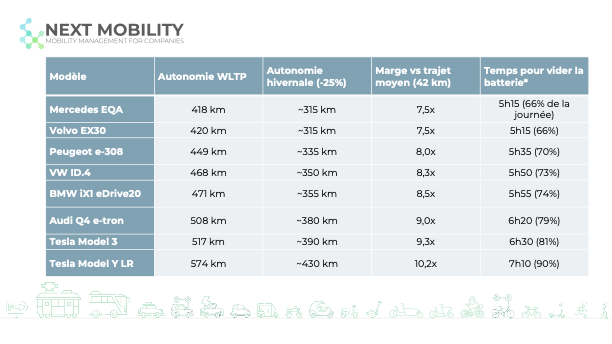
Here’s what this looks like in practice with the most common fleet vehicles in Belgium in 2026:
| Model | WLTP range | Winter range (-25%) | Margin vs average commute (42 km) | Time to drain battery* |
|---|---|---|---|---|
| Mercedes EQA | 418 km | ~315 km | 7.5x | 5h15 (66% of working day) |
| Volvo EX30 | 420 km | ~315 km | 7.5x | 5h15 (66%) |
| Peugeot e-308 | 449 km | ~335 km | 8.0x | 5h35 (70%) |
| VW ID.4 | 468 km | ~350 km | 8.3x | 5h50 (73%) |
| BMW iX1 eDrive20 | 471 km | ~355 km | 8.5x | 5h55 (74%) |
| Audi Q4 e-tron | 508 km | ~380 km | 9.0x | 6h20 (79%) |
| Tesla Model 3 | 517 km | ~390 km | 9.3x | 6h30 (81%) |
| Tesla Model Y LR | 574 km | ~430 km | 10.2x | 7h10 (90%) |
*At an average speed of 60 km/h (Belgian urban/suburban mix). Percentage of an 8-hour working day.
The lowest-performing vehicle on this list still offers 7.5 times the distance of the average Belgian commute — in winter.
To put it another way: to completely drain the battery of the lowest-performing model in winter conditions, you’d need to drive continuously for over 5 hours, or two-thirds of a working day. No fleet driver spends five hours behind the wheel.
In practice, even with the worst winter range, a driver would need to recharge their vehicle about once a week to cover their commutes. Not every day.
3. Charging infrastructure: an outdated argument
In August 2025, Belgium had over 106.000 public and semi-public charging points (EAFO / EV Belgium data). The country ranks in Europe’s top 5 — alongside the Netherlands, Germany, France, and the United Kingdom, which together represent 66% of total European infrastructure.
The distinction between slow and fast chargers is important:
| Charger type | Number (2025) | Annual growth |
|---|---|---|
| AC — standard charging (≤ 22 kW) | ~99.300 | +22% |
| DC — fast charging (> 150 kW) | ~5.500 | +57% |
93% of public charging points are AC chargers (alternating current, ≤ 22 kW). That makes sense: they cover daily needs — workplace charging, street charging, retail parking. With an 11 kW AC charger, a fleet vehicle recovers between 50 and 73 km per hour of charging, or the average commute in 35 to 50 minutes. For the vast majority of drivers, slow charging is more than sufficient.
The ~5.500 fast DC chargers (> 150 kW) are designed for long trips and top-up charging. Their number increased 57% in one year. The number of operators offering fast charging doubled, from 30 to 60 between 2023 and 2024. You recover 10 to 80% of battery capacity in 20 to 30 minutes.
Regional distribution:
| Region | Charging points | Public/semi-public stations |
|---|---|---|
| Flanders | 82.356 | 22.310 |
| Wallonia | 14.191 | 3.700 |
| Brussels | 10.130 | 3.850 |
National target : 220.000 charging points by 2030, doubling in 5 years.
Investments are concrete: Fastned operates over 400 stations, Allego is deploying over 5.000 points in Flanders and 34 new fast hubs in Wallonia, Wereldhave is installing 350+ chargers (including 60+ ultra-fast DC) in its shopping centers. In Brussels, the ChargyClick program installed 3.500 street chargers in less than two years.
The regional gap exists : Wallonia lags with 3.700 stations versus 22.310 in Flanders. This is a real concern for fleets with drivers in rural Walloon areas. But it’s an acceleration problem, not a feasibility problem.
4. The real cases of EV electro-incompatibility
Intellectual honesty requires acknowledging that EV electro-incompatibility exists — for a minority of profiles. Here are the cases where it’s legitimate:
More than 300 km per day, with no opportunity to charge in between. This applies to some long-haul salespeople or traveling technicians. According to Belgian mobility data, this affects less than 3% of the active population. And even for these profiles, fast DC charging (20 minutes for 10-80%) can solve the problem if scheduling allows.
No access to home or workplace charging. About 35% of Belgian households don’t have private parking. But this proportion is declining as street charging points proliferate and employers install chargers in their parking lots. It’s a real barrier in 2026, but not a permanent one.
Regular heavy towing. Towing reduces range by 30 to 50%. For profiles that regularly tow trailers or heavy equipment, current fleet EVs are still insufficient. It’s a niche case, but real.
Multi-country trips through areas with weak coverage. Rural Eastern Europe, some regions of southern Spain or Portugal remain less well-served. For profiles with frequent business travel to these areas, an EV can pose problems.
Honestly? These cases represent between 3% and 8% of Belgian fleet drivers, depending on fleet composition.
5. The family question: stop sizing for vacations
“I need a seven-seater, I have three children.” It’s the most frequent objection from families. It deserves an honest answer — not just a list of models.
Seven-seat EVs exist. It’s true. The Kia EV9, Peugeot e-5008, VW ID.Buzz Long, Volvo EX90, and Tesla Model X are all available on lease in Belgium.
But the real question is: do you need it 365 days a year?
A family of five (2 adults + 3 children) needs… five seats. The two extra seats are only needed in occasional situations: a friend of the children joining the trip, grandparents, a vacation with an extra passenger. Counting generously, that’s 15 to 25 days per year.
For families larger than five, you’ll need to look at bigger vehicles (ID.Buzz LWB, Mercedes EQV, Volvo EX90, Kia EV9, etc.), which are often quite costly to buy and operate due to their higher consumption — we should be honest about that.
The TCO monthly surcharge is considerable. Here’s operational leasing data (source: Directlease.be, 2025-2026 rates, all-inclusive: lease, insurance, maintenance, taxes):
| Comparison | 5-seat (TCO/month) | 7-seat (TCO/month) | Monthly surcharge | Annual surcharge |
|---|---|---|---|---|
| Tesla Model Y vs Model X | ~650 € | ~1.100 € | +450 € | +5.400 € |
| Volvo EX40 vs EX90 | ~670 € | ~1.160 € | +490 € | +5.880 € |
| Kia EV6 vs EV9 | ~600 € | ~800 € | +200 € | +2.400 € |
For seats sitting empty 340 days a year.
The solution is in the mobility budget. Pillar 2 includes car rental without a driver, for a maximum of 30 calendar days per year. That’s exactly the use case for occasional seven-seaters.
The math: 20 days renting a seven-seat minivan or SUV at ~100 €/day = 2.000 €/year. Annual surcharge for a seven-seater lease: 2.400 to 5.880 €/year. The rational choice is an efficient five-seater for daily use + occasional rental for exceptions. Net savings: 400 to 3.880 €/year.
As mobility researcher Aurélien Bigo puts it: a car weighs about 10 times what it carries (passengers + luggage). The bigger the vehicle, the worse this ratio. Sizing your daily car for 15 vacation days means accepting to move 2.5 tonnes 350 days a year to transport an average of 2 passengers.
6. Bigger ≠ better: the battery size trap
The other frequent reflex: “I want the largest battery possible, to have peace of mind.” It’s intuitive. It’s often counterproductive.
A larger battery means a heavier vehicle. A heavier vehicle consumes more. And a vehicle that consumes more doesn’t gain proportionally in range. Worse: it charges more slowly in kilometers recovered per hour.
Let’s take four vehicle profiles available in Belgium:
| Kia EV3 | Tesla Model Y | VW ID.Buzz LWB | Kia EV9 | |
|---|---|---|---|---|
| Battery | 58 kWh | 60 kWh | 86 kWh | 100 kWh |
| Weight | 1.580 kg | 1.878 kg | 2.498 kg | 2.614 kg |
| Real consumption | ~15 kWh/100 km | ~16 kWh/100 km | ~22 kWh/100 km | ~23 kWh/100 km |
| Price (VAT incl.) | ~38.000 € | ~40.000 € | ~60.000 € | ~63.000 € |
| Winter range | ~270 km | ~300 km | ~270 km | ~305 km |
The ID.Buzz has a 48% larger battery than the Kia EV3, but nearly identical winter range. Weight and consumption absorb the capacity gain.
In daily use, home charging is what matters. With the same 11 kW charger installed at the driver’s home:
| Vehicle | km recovered per hour (11 kW) | Time to recover 46 km (large company avg. commute) |
|---|---|---|
| Kia EV3 | 73 km/h | 38 min |
| Tesla Model Y | 69 km/h | 40 min |
| VW ID.Buzz | 50 km/h | 55 min |
| Kia EV9 | 48 km/h | 58 min |
A light, efficient vehicle recovers the daily commute in half an hour. A heavy SUV needs almost an hour for the same result on the same charger.
And on long trips? DC charging speed is higher on larger vehicles (240-250 kW vs 128 kW for the EV3), but the advantage is partly offset by consumption. The Tesla Model Y remains the most efficient market compromise: relatively light, fast charging (175 kW for the standard version), and contained consumption.
The right question isn’t “what’s the largest battery?” but “which vehicle suits my 350 days of daily use?” Your daily car isn’t your vacation car. And like the seven-seater question: the mobility budget covers the exceptions (rental, train, plane).
7. The second car: an asset, not a failure
There’s an argument rarely heard in the EV electro-incompatibility debate: the second car.
In Belgium, many households own two cars. In that case, the question isn’t “can the EV do everything?” but “can the EV cover 90% of our needs?” The answer is almost always yes. The primary car — the one that makes the daily commute — is the ideal candidate for electric. The second car can cover the rare cases where range isn’t enough, while infrastructure and models continue to improve.
And for single-car households, the question is different: in 2026, an EV with 315 km winter range covers nearly all daily needs. The few long trips each year are solved by a 20-minute stop at a fast DC charger — time for a coffee.
A personal experience. Between 2017 and 2019, I drove a first-generation Nissan Leaf daily. Real range: about 100 km. One hundred kilometers. Not three hundred, not five hundred. One hundred. In 2017, public charging points in Belgium could be counted on your fingers. I searched for plugs, I planned my trips, and in two years, I was never stuck. I eventually sold it — not to go back to gas, but for a cargo bike.
If 100 km of range was enough in 2017 with almost no infrastructure, what about 315 to 430 km of winter range in 2026 with over 106.000 charging points?
EV electro-incompatibility isn’t a fixed characteristic. It’s a dial that moves every year — in the right direction.
8. The Belgian paradox: fleets leading the way
One figure sums up the Belgian situation: 86% of all-electric vehicle registrations in 2025 come from the fleet and leasing market (FEBIAC/ICCT data).
| Segment | EV share in new registrations |
|---|---|
| Company cars | ~40% |
| Private purchases | ~10% |
Belgium ranks in Europe’s top 4 for EV registrations (alongside Germany, the Netherlands, and France), with a market share of 35% in 2025. But this performance is almost exclusively driven by the company car market, thanks to tax incentives.
What this means for fleet managers : fleet electrification is no longer a pilot project. It’s the market standard. The 60% of fleets that haven’t yet switched are behind the curve, not ahead.
9. EV electro-incompatibility is a 2020 diagnosis
In 2020, the average range of a popular EV was around 250 km WLTP. Belgium had fewer than 20.000 public charging points. Seven-seat options barely existed. The EV electro-incompatibility argument made sense.
In 2026, the data has changed:
- Average range: 450-550 km WLTP (315-430 km in winter)
- Public charging points: 106.000+ (including ~5.500 fast DC, +57%/year)
- Seven-seat options: 6+ models available
- Fast charging: 10-80% in 20-30 minutes (standard)
- Average home-to-work commute: 21 km (federal survey, 1.6 million workers)
EV electro-incompatibility still exists, but it affects a very specific profile: more than 300 km daily, no access to charging, regular heavy towing. That profile exists. It represents less than 5% of fleet drivers.
For the remaining 95%, it’s not a technical problem. It’s an information problem.
Are you planning your fleet’s electrification and want analysis by driver profile? Next Mobility supports Belgian companies through the transition, with real data and a pragmatic approach. Contact us for an initial conversation.
Sources:
- SPF Mobilité et Transports, Enquête fédérale sur les déplacements domicile-travail 2021-2022 (9.731 unités d’établissement, 1.623.689 travailleurs)
- SPF Mobilité et Transports, Enquête BeMob sur les déplacements domicile-travail 2022-2023
- Recurrent Auto, Winter EV Range Loss Study 2024-2025 (18.000+ véhicules, 22 modèles, 11 marques)
- Fédération automobile norvégienne (NAF), test hivernal annuel 2024-2025 (24-29 modèles)
- European Alternative Fuels Observatory (EAFO), données infrastructure Belgique 2025
- EV Belgium, communiqué de presse “100.000 bornes”, août 2025
- Directlease.be, données TCO leasing opérationnel Belgique 2025-2026
- ACEA, immatriculations de voitures particulières et véhicules commerciaux, 2025
- FEBIAC / ICCT, données d’immatriculation belges 2025
- Aurélien Bigo, chercheur en mobilité, données sur le ratio poids/passagers