

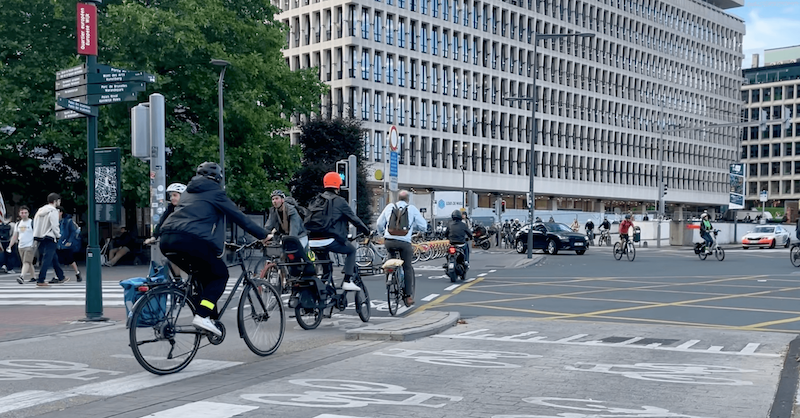
Ghent in 3rd place globally, Antwerp in the top 10, Brussels progressing… The Copenhagenize Index 2025 – EIT Urban Mobility Edition confirms that Belgium is establishing itself as a major player in cycling mobility in Europe. For companies looking to implement a sustainable mobility policy, these results offer valuable lessons and concrete opportunities.
The Copenhagenize Index: the global reference for bicycle-friendly cities
Published in November 2025, the Copenhagenize Index evaluates 100 cities from 44 countries according to 13 indicators grouped into three pillars:
- Safe & Connected Infrastructure: bicycle infrastructure, bicycle parking, traffic calming, safety
- Usage & Reach: bicycle modal share, modal share growth, women’s share of bicycle trips, bike-share systems, cargo bikes
- Policy & Support: political commitment, advocacy, image of the bicycle, urban planning
This rigorous methodology makes it the international reference for evaluating a city’s bicycle-friendliness, far beyond a simple ranking.
Ghent: the revolution of a medium-sized city that became a global model
3rd place globally: a remarkable achievement
With an overall score of 67.6 points, Ghent climbs to 3rd place globally, ahead of Amsterdam (4th) and behind Utrecht and Copenhagen. It’s the best-ranked Belgian city and an inspiring example for any medium-sized city seeking to transform its mobility.
Ghent’s detailed scores:
- Infrastructure: 59.2
- Usage: 66.1
- Policy: 83.1 (exceptional score)
What particularly distinguishes Ghent is its remarkable policy score of 83.1, the highest in the ranking. This testifies to strong and consistent political commitment over time.
The 2017 circulation plan: the decisive turning point
Ghent’s transformation is based on a bold circulation plan implemented in 2017. The goal wasn’t to ban cars, but to rethink the hierarchy of movement by prioritizing active mobility and public transport.
The results are spectacular:
- Bicycle modal share: 34% (versus 22% ten years ago)
- Nearly 20 km of bicycle streets
- Over 300 km of protected bicycle lanes strategically placed
- Connection to the regional cycle superhighway network
The city center was transformed: motorized traffic redirected to the ring road, parking moved underground, and freed space converted into public squares, bicycle streets, and calmed zones.
Lessons for businesses
Ghent demonstrates that political consistency takes precedence over massive investment. Since 1992, the city has built its strategy around four pillars: functional infrastructure, parking, awareness, and dedicated governance.
For a company established in Ghent or a similar city, this means:
- Employees who can truly use bicycles daily
- Mature and safe cycling infrastructure
- Abundant bicycle parking solutions
- An ecosystem favorable to company bikes
Antwerp: the successful marriage of port and bicycle
8th place: when industry and cycling coexist
Antwerp proves that a port and industrial city can also be a bicycle-friendly city. With 64.4 points, Belgium’s largest municipality ranks 8th globally.
Antwerp’s detailed scores:
- Infrastructure: 51.2
- Usage: 75.4 (exceptional score)
- Policy: 63.9
The exceptional usage (75.4) demonstrates that Antwerp residents have massively adopted cycling in their daily trips. 55% of commuting trips by bicycle are made by women, a sign of real democratization.
An ambitious infrastructure strategy
Antwerp has:
- Nearly 600 km of protected bike lanes
- 22 km of bicycle streets
- Over 70% of streets in 30 km/h zones
- The “100 missing links” program: major investments in underpasses and bridges to ensure route continuity
Bicycle parking innovation
In a dense city where many homes lack bicycle storage space, Antwerp has developed an innovative approach:
- Over 60 neighborhood parking sites
- Over 1,600 spaces available
- Conversion of underused premises into secure bicycle parking
- Accessible subscription system
This adaptive reuse offers a transferable model for other cities facing similar challenges.
Implications for Antwerp businesses
For companies based in Antwerp, these results mean:
- A pool of employees already accustomed to cycling
- Extensive cycling infrastructure facilitating company bikes
- Innovative bicycle parking solutions to replicate
- The ability to rely on a well-established cycling culture
Antwerp’s challenge remains to maintain this momentum while navigating the complexity of its port and industrial development.
Brussels: encouraging progress (32nd place)
Specific assets and challenges
Brussels ranks 32nd globally with 50.0 points. For a densely populated and multilingual European capital, this position reflects both real progress and persistent challenges.
Brussels’ detailed scores:
- Infrastructure: 42.6
- Usage: 54.2
- Policy: 44.2
The usage score of 54.2 shows that Brussels residents are increasingly using bicycles, despite infrastructure still under development (42.6).
The capital’s specifics
Brussels faces unique challenges:
- High traffic density
- Shared competencies between 19 municipalities
- Significant transit traffic
- Sometimes hilly terrain
Yet the city has made notable progress in recent years, with the expansion of low-emission zones, new cycle paths, and the development of the Villo! system.
Opportunities for Brussels businesses
For companies in the capital:
- Significant growth potential
- A population increasingly receptive to cycling
- Regional incentives for soft mobility
- The opportunity to position as pioneers
Companies investing now in bicycle mobility solutions in Brussels will benefit from the continuous improvement of infrastructure and the cultural acceleration toward active mobility.
What these rankings mean for your company
1. Location matters enormously
The Copenhagenize Index results confirm what the federal mobility survey revealed: local context is determinant.
- A company in Ghent can rely on mature infrastructure
- In Antwerp, you benefit from a strong cycling culture
- In Brussels, you ride a wave of transformation
Your company travel plan must adapt to this specific context.
2. Cycling infrastructure boosts usage
The Copenhagenize Index demonstrates a direct correlation between infrastructure quality and usage. Cities investing in safe and continuous bike lanes see their modal share explode.
For companies, this means:
- Verifying the quality of cycling access to your sites
- Investing in charging infrastructure for electric bikes
- Creating secure and covered bicycle parking
- Setting up changing rooms and showers
3. The electric bike is a game-changer
The Copenhagenize Index 2025 notes spectacular progress in electrically-assisted bicycles. This trend, confirmed by the Belgian federal survey (64% of cycling km are electric), significantly expands the potential of company bikes.
With an electric bike:
- Home-to-work distances up to 15-20 km become comfortable
- Terrain is no longer an obstacle
- Physical effort is controlled
- Arrival at the office remains professional
4. Diversity is an indicator of maturity
The best-ranked cities are distinguished by cyclist diversity: women (55% in Antwerp), children, seniors, all socio-economic profiles.
For companies, this means that company bike vs company car is no longer a marginal choice but a mainstream option attracting all employee profiles.
5. Political consistency inspires corporate consistency
Ghent’s success is based on 30 years of consistent policy. Companies can draw inspiration from this approach:
- Define a clear internal mobility policy
- Inscribe it long-term (not a fad)
- Mobilize all departments (HR, facility, IT)
- Measure and communicate progress
Concretely: how to leverage these results
For companies in Ghent
Your assets:
- World-class cycling infrastructure
- Very established cycling culture
- Abundant bicycle parking
Priority actions:
- Offer the mobility budget with attractive bicycle options
- Invest in company electric bike fleets
- Organize inter-company cycling challenges
- Make cycling an element of your employer brand
For companies in Antwerp
Your assets:
- Strong bicycle adoption (75.4 in usage)
- Extensive 600 km network
- Innovative parking solutions
Priority actions:
- Negotiate collective subscriptions to neighborhood bike parking
- Develop cargo bikes for urban logistics
- Create partnerships with local cycling actors
- Draw inspiration from Antwerp’s space reuse model
For companies in Brussels
Your assets:
- Ongoing transformation dynamic
- Receptive population (54.2 in usage)
- Available regional incentives
Priority actions:
- Become an early adopter to benefit from support
- Massively invest in internal infrastructure (parking, showers)
- Train and raise awareness among employees (sustainable mobility coaching)
- Actively participate in advocacy to improve local infrastructure
Toward corporate mobility inspired by champions
The Copenhagenize Index 2025 doesn’t just rank cities. It reveals recipes for success and conditions for transformation.
The 5 principles of champion cities
- Long-term vision: Ghent has been planning since 1992
- Continuous investment: no stop-and-go
- Systemic approach: infrastructure + parking + awareness + governance
- Measurement and adaptation: collect data, adjust continuously
- Political courage: dare to redistribute public space
These principles apply perfectly to corporate mobility policies.
The Belgian opportunity
With three cities in the global top 32, including one in the top 3, Belgium has a cycling ecosystem among the best in Europe.
For Belgian companies, this is a unique opportunity:
- Attract international talent sensitive to quality of life
- Significantly reduce company carbon footprint
- Decrease mobility costs (parking, vehicle fleet)
- Improve employee health and well-being
- Position as a responsible employer
Conclusion: from ranking to action
The Copenhagenize Index 2025 demonstrates that cycling is no longer a niche mode of transport but a strategic pillar of modern urban mobility.
For Belgian companies, the excellent results of Ghent, Antwerp, and Brussels’ progress create an extremely favorable context for implementing sustainable mobility solutions.
Whether you’re an HR manager, CEO, CFO, or Facility manager, three questions arise:
- Where does your company stand relative to the standards established by these champion cities?
- How to leverage your city’s favorable local context?
- What concrete actions to launch in the next 6 months?
The transformation of corporate mobility won’t happen overnight. But as Ghent has demonstrated, consistency and perseverance transform entire cities. Companies adopting the same approach will transform their mobility and, consequently, their employer attractiveness and environmental impact.
Cycling isn’t the future of urban mobility. It’s the present, as proven by the Copenhagenize Index 2025. The real question is no longer “should I invest in cycling?” but “how to accelerate this transformation in my company?”
Source: The Copenhagenize Index 2025 – EIT Urban Mobility Edition
Is your company ready to join the movement? Whether you’re based in Ghent, Antwerp, Brussels, or elsewhere in Belgium, let’s discuss how to transform these urban successes into opportunities for your corporate mobility policy.