

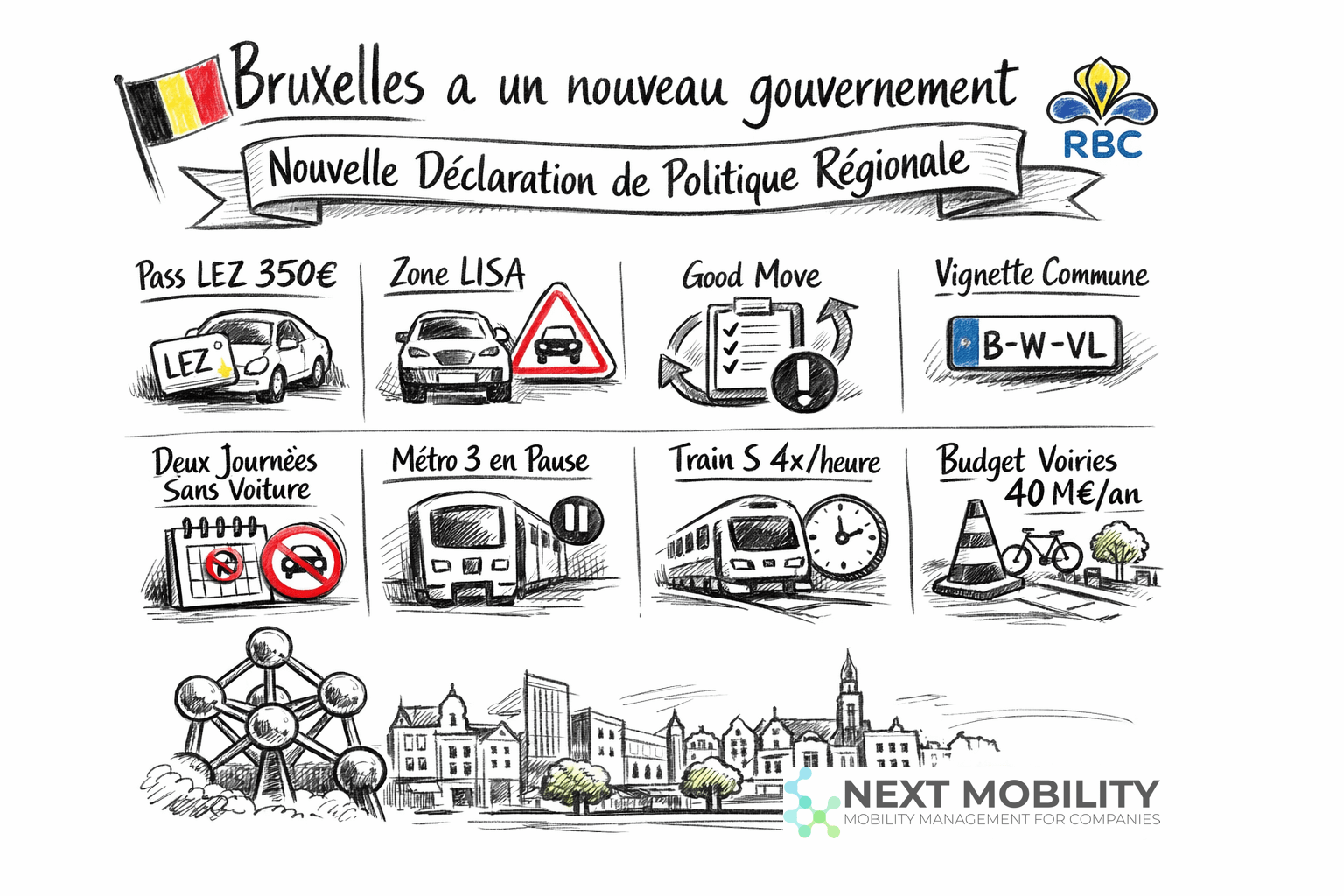
The regional policy declaration of Brussels’ new government came out last week. Twenty-four pages that outline Brussels policy for the next five years.
I’ve reviewed the document thoroughly. The good news: this declaration is more pragmatic than the previous one. The direction, however, hasn’t changed. Brussels wants fewer cars, lighter vehicles, and better shared solutions. For fleet managers, HR teams, and CFOs, each measure has concrete consequences.
Here are the 10 measures that matter, with their practical implications for each.
1. LEZ: An Annual Pass at 350 € Replaces Recurring Fines
This is arguably the most tangible measure for fleets. Brussels’ current LEZ system is based on fines of 350 € per quarter, meaning a maximum of 1,400 € per year for a non-compliant vehicle. The new government is changing this logic.
The new system provides an annual pass at 350 € (indexed) for vehicles that do not meet LEZ standards. A social category is provided at 200 €, and the fine for those driving without a pass will be capped at 80 € per month. Exemptions will be provided for professional situations and vulnerable individuals.
As a reminder, since January 1, 2026, Euro 5 diesel and Euro 2 petrol vehicles are prohibited in Brussels’ LEZ. A grace period with warnings applies until March 1, 2026 before the first fines.
Fleet Impact: For companies that still have a few vehicles in transition (such as Euro 5 diesel utility vehicles), the 350 €/year pass is far more predictable than the quarterly fine system. It’s a manageable cost while completing your fleet renewal. But let’s not lose sight of the original purpose of the LEZ, which remains essential: air quality in Brussels.
2. LISA Zone: Towards Lighter Vehicles in the City
The government announces the implementation of a LISA zone (Light and Safe), progressively limiting access for the heaviest private vehicles. The timeline and weight thresholds are not yet defined, but the principle is established in the declaration.
This measure makes sense. A lighter vehicle consumes less energy (electric or thermal), takes up less road space, causes less infrastructure wear, and is statistically safer for pedestrians and cyclists. It’s a basic physics principle: kinetic energy increases proportionally to mass.
Fleet Impact: This is an additional argument for sizing your fleet reasonably. Market trends push towards ever larger and heavier SUVs. LISA goes in the opposite direction: favoring compact and lightweight vehicles. For car policies under review, now is the time to integrate a maximum weight criterion. A 1,800 kg vehicle performs the same function as a 2,500 kg vehicle for most business trips, with a lower TCO.
3. Good Move: Evaluation and New Regional Mobility Plan
The Good Move plan—which has generated considerable debate—will be evaluated by the new government and then replaced by a new Regional Mobility Plan (PRM). The fundamental principles remain: modal shift, traffic calming, and public space sharing. But the operational framework will be revised.
The declaration specifies that circulation plans will continue with smaller perimeters, centered around schools, respecting the STOP principle (pedestrians first, then cyclists, public transport, and finally private vehicles; STOP is the Dutch acronym for Stappen, Trappen, Openbare vervoer, Privé voertuig—walking, cycling, public transport, and private vehicle).
Fleet Impact: Local circulation plans will continue to alter routes in certain neighborhoods. For fleets with deliveries or regular movements in Brussels, it’s useful to track the evolution of the PRM and maintain good knowledge of local restrictions. Citizen consultation will be strengthened, meaning companies will have the opportunity to make their voice heard when these plans are designed.
4. Vehicle Tax Harmonized with Flanders and Wallonia
The Brussels government commits to harmonizing the vehicle tax with the other two regions. In practice, this means a single system instead of three potentially different ones.
Fleet Impact: For fleet managers who operate vehicles across all three regions—the case for the majority of Belgian fleets—this is a welcome administrative simplification. A single regulatory framework, a single procedure. It’s the type of measure that doesn’t make headlines but genuinely facilitates daily management. Details (amount, procedures, timeline) remain to be defined, but the political will for harmonization is clear.
5. Enhanced S Train: Minimum 4 Trains per Hour
The Brussels government is requesting that SNCB provide a minimum of 4 trains per hour at each station on the S network. This is a regional request, not a guarantee, since rail is a federal competency. But the political signal is clear.
The S (Suburban) network serves Brussels and its suburbs via stations such as Schuman, Luxembourg, Brussels-Central, but also Etterbeek, Watermael, Uccle-Calevoet, and many others. With 4 trains per hour, frequency improves to one train every 15 minutes, making the train genuinely competitive with the car for commutes.
Mobility Impact: For companies located near an S network station, this is a concrete lever to encourage rail use among employees. Combined with an SNCB subscription (mandatory employer reimbursement) and a last-mile solution (shared bike, scooter, bus), the S train can become a genuine alternative to the company car. This is exactly the type of combination that the mobility budget allows you to finance via pillar 2.
6. Metro 3 Suspended: Budgetary Realism
The Metro 3 project, which was supposed to connect north and south Brussels via a new line, is suspended for reassessment. The tunnels of the Constitution section (Albert-North axis) will continue, but the rest of the route is frozen while analyzing costs, timelines, and possible alternatives.
This decision is understandable given the project’s cost explosion. Alternatives such as long electric bus lines (BRT) in dedicated lanes could offer better cost-effectiveness for faster deployment.
Mobility Impact: In the short term, no direct impact. But in the medium term, this means that public transport supply on the north-south axis will not transform as quickly as hoped. Companies located along this corridor will need to continue relying on existing buses and trams, supplemented by multimodal solutions.
7. 40 Million Euros Per Year for Road Redesign
The government plans an annual budget of 40 million euros for road redesign to support modal shift. Concretely, this means: more secure bike lanes, improved bus corridors, and replacement of temporary concrete blocks with modular and vegetated urban furniture.
The principle is simple and mathematical: a bus or tram transports far more passengers per square meter of roadway than an individual car. The same applies to bicycles—you fit more bicycles per square meter than cars. Reallocating space for the most efficient modes is consistent with mobility objectives.
Mobility Impact: In the coming months and years, automotive traffic in Brussels will continue to shrink in terms of available space. Companies that anticipate this evolution by developing multimodal options for their employees will have an advantage. Those that remain in a “one person = one car” model will experience increasing travel times and reduced accessibility. It’s like with electrification—alternatives (or combinations of them) are quite realistic in many cases, knowing that according to the latest federal survey, 50% of workers who travel less than 5 km to work do so by car. And for trips of 5 to 15 km, the car represents 67% of journeys. The problem isn’t the distance. It’s habit.
8. Parking: Encouraging Off-Street Parking
The declaration plans to encourage off-street parking (underground car parks, park-and-ride facilities), develop dynamic pricing, and harmonize rates between municipalities. Professional parking exemption cards will be maintained and expanded.
Fleet Impact: For fleets that depend on on-street parking in Brussels, the shift towards dynamic pricing will make parking costs more variable and potentially higher during peak hours and in central zones. Park-and-ride facilities combined with last-mile solutions become a serious alternative to consider. For utility vehicles, the expansion of professional cards is good news.
9. Second Car-Free Day Starting in 2027
In addition to the traditional car-free Sunday in September, a second day will be introduced starting in 2027, during Iris week (late April/early May). This is a symbolic but also practical signal.
Fleet Impact: Two days per year when motorized vehicles cannot circulate in the Region. For fleets, this is limited impact but requires planning, especially if it’s not a Sunday: anticipate deliveries, reprogram business travel, organize remote work. Exemptions exist for essential services, but it’s best to integrate these dates into your logistics calendar.
10. Construction Site Coordination and Tram Tour & Taxis
The government commits to better coordinating mobility construction projects to limit disruptions. The Tram Tour & Taxis is confirmed, which will improve service to this rapidly developing neighborhood.
Fleet Impact: Better construction site coordination has been expected for a long time by all road users. For fleets, this should translate into better route predictability and fewer improvised detours.
What This All Means for Your Mobility Policy
Stepping back, the 10 measures paint a coherent picture. Brussels is continuing its transformation toward a city less dependent on the individual car. The new government is more pragmatic in its approach (LEZ pass rather than fines, Good Move evaluation, Metro 3 suspension due to excessive costs), but the strategic direction remains the same.
For fleet managers and mobility leaders, three action areas emerge:
Rationalize the fleet. LISA zone, rising parking costs, reduced circulation space: everything points toward smaller, lighter vehicles used more efficiently. The question is no longer “which vehicle for which employee” but “what mobility mix for which need”.
Develop multimodality. Enhanced S train, redesigned roads, federal mobility budget: alternatives to the car are becoming increasingly credible and attractive. The mobility budget (mandatory for employers since 2024 for those offering company cars) is the perfect tool to finance these combinations: public transport subscriptions, company bikes, shared scooters, car-sharing, all through pillar 2.
Anticipate rather than react. Companies that integrate these developments now into their car & mobility policy and corporate mobility plan will have a competitive advantage in terms of employer attractiveness, cost control, and regulatory compliance.
The regional policy declaration is just a framework of intentions. Implementing decrees will follow in the coming months. But the signals are clear enough to act now.
Want to assess the impact of these measures on your fleet or mobility policy? Contact me to discuss.
Sources
- Regional Policy Declaration of the Brussels Government, February 2026
- LEZ.brussels — Low Emission Zone Calendar and Procedures
- FPS Mobility — Federal Home-to-Work Travel Diagnostics
- FEBIAC — Belgian Market Registration Statistics 2025