

Belgian workers’ mobility is evolving, but slower than we might hope. The Federal Mobility Survey, conducted between September 2024 and September 2025 among 13,613 adults, reveals crucial trends for any company looking to implement a sustainable internal mobility policy.
Cars still dominate commuting
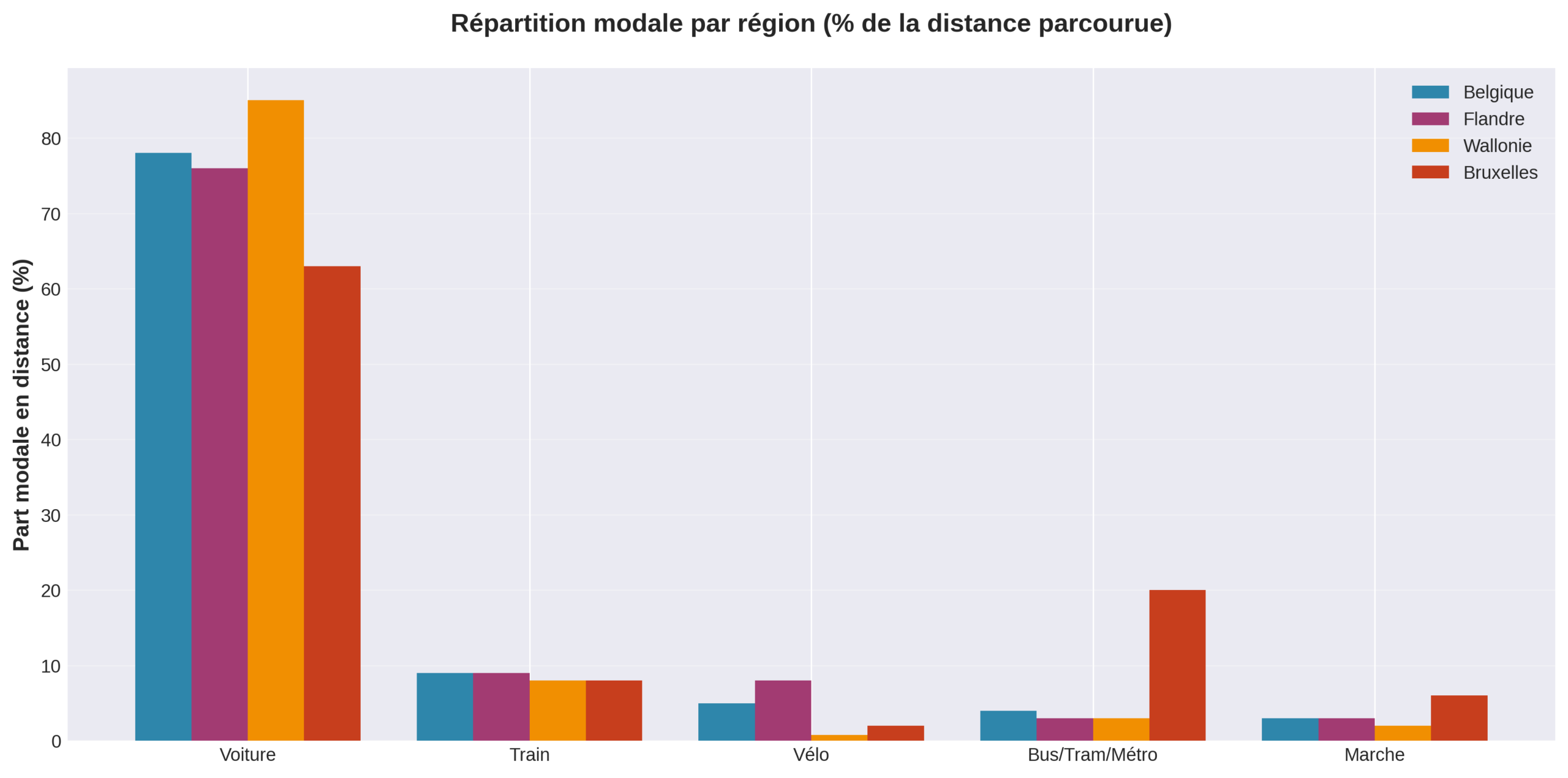
The figures are clear: 78% of kilometers traveled by Belgians are by car. This dominance persists despite efforts toward more sustainable mobility. For commuting specifically, this mode of transport represents even 84% of distances traveled.
This reality poses a major challenge for companies wanting to reduce their carbon footprint. Sustainable fleet management becomes a strategic issue, particularly through the electrification of vehicle fleets.
Marked regional differences
The survey reveals significant disparities by region:
In Flanders
- 16% of trips are by bicycle (versus only 1.5% in Wallonia)
- Cycling represents 8% of distance traveled
- Active modes are well integrated into daily mobility
In Brussels
- 28% of travel loops are by public transport or on foot
- Cars represent only 43% of trips (versus 73% in Wallonia)
- Public transport infrastructure plays a major role
In Wallonia
- 85% of distance traveled is by car
- Alternatives remain limited, particularly in rural areas
- The need for employee mobility solutions is crucial
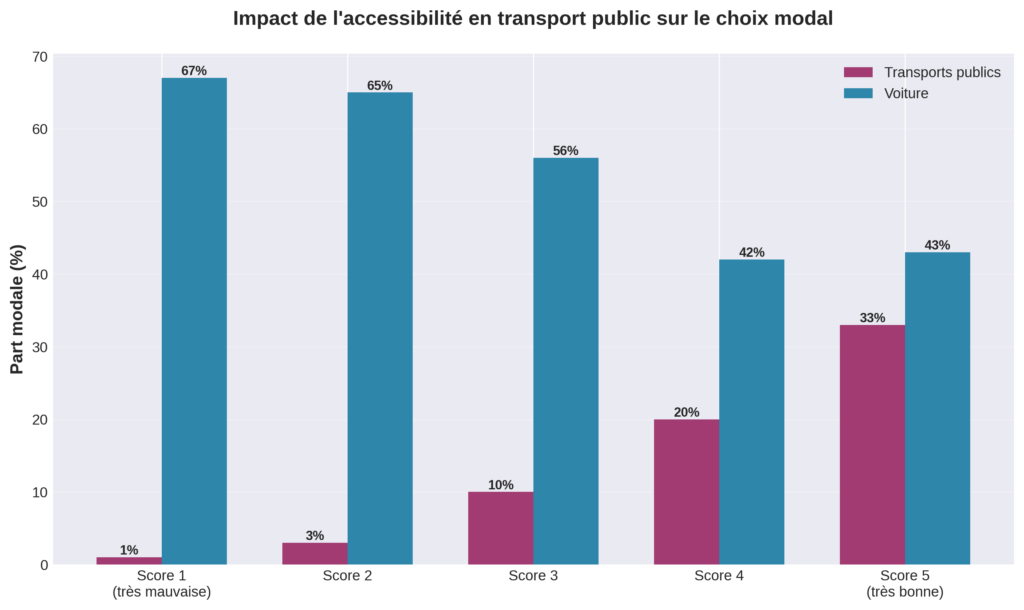
The importance of public transport accessibility
The study demonstrates that accessibility to public transport radically influences mobility choices. In the best-served areas (score 5/5), 33% of trips are by public transport. In poorly served areas, this figure drops to 1%.
This data is essential for developing a company travel plan. The location of offices and the quality of public transport services largely determine the options available to your employees.
The electric bicycle: a revolution in motion
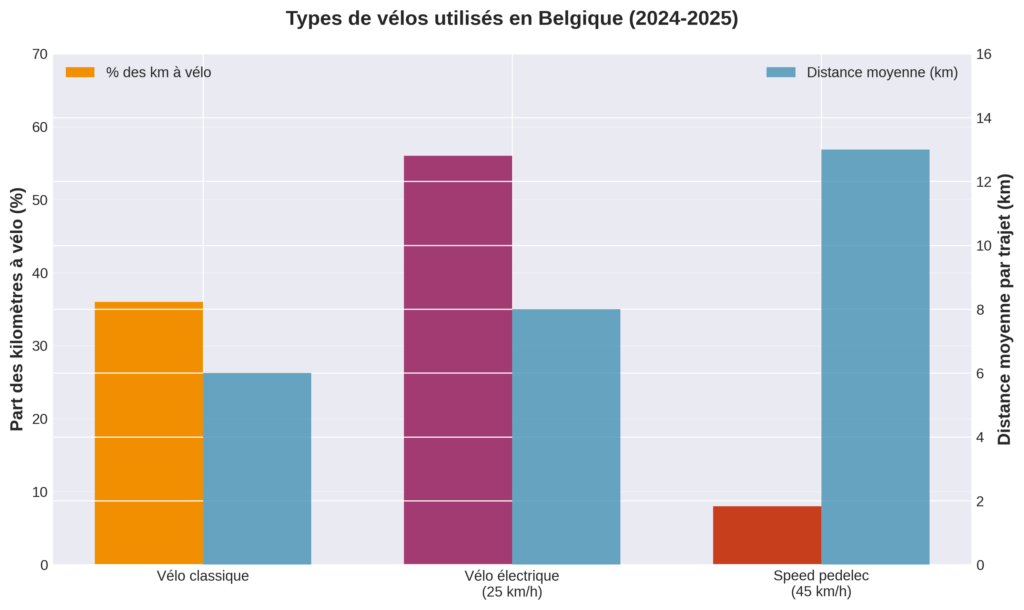
A major change is occurring in active mobility: 64% of kilometers traveled by bicycle are now with electric assistance. Electric bicycles enable longer distances:
- Traditional bicycle: 6 km on average per trip
- Electric bicycle (25 km/h): 8 km on average per trip
- Speed pedelec (45 km/h): 13 km on average per trip
This progress opens new perspectives for company bikes vs company cars. For many commutes, the electric bicycle becomes a credible alternative, especially in urban or peri-urban areas.
Travel purposes: prioritizing flexibility
The survey reveals that 32% of distance traveled is work-related, but 40% of trips concern shopping and services, and 31% leisure.
This diversity of purposes underscores the importance of the company mobility budget, which allows employees to choose solutions adapted to all their travel needs, not just commuting.
Distance: determining factor in mode choice
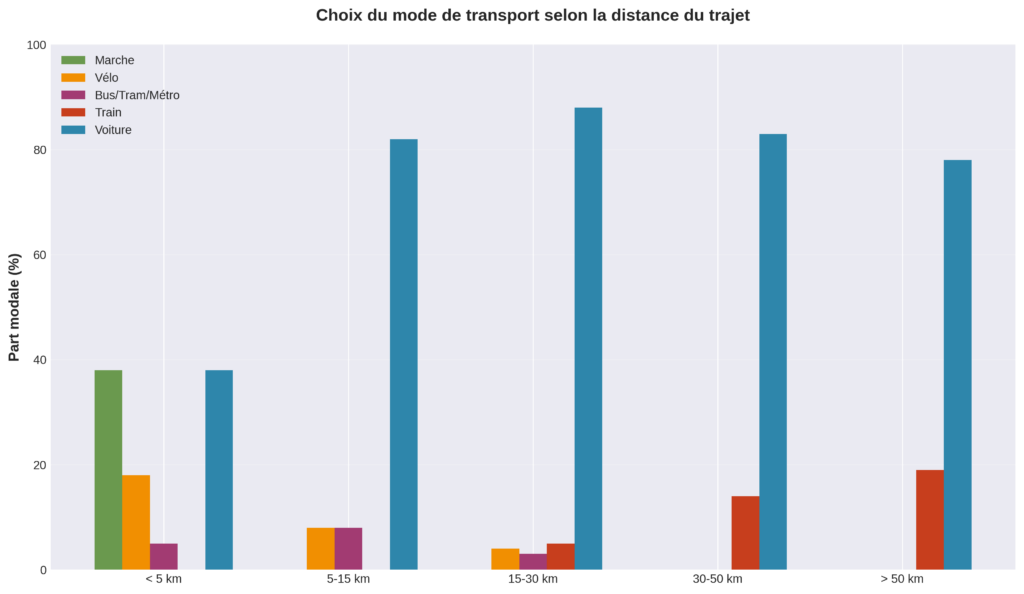
The data clearly shows that the choice of transport mode strongly depends on the distance to be traveled:
Less than 5 km
- Walking: 38% of trips
- Bicycle: 18%
- Car: 38%
5-15 km
- Car: 82%
- Bus/tram/metro: 8%
- Bicycle: 8%
15-30 km
- Car: 88%
- Train: 5%
- Other modes: marginal
More than 50 km
- Car: 78%
- Train: 19%
- Alternatives almost non-existent
These figures confirm that an effective mobility policy must offer solutions adapted to different distance categories. Shared company vehicle fleets can play a complementary role for intermediate distances.
Practical implications for companies
1. Adapt strategy to location
A Brussels-based company can focus on public transport and bicycles. In rural Wallonia, fleet electrification and carpooling will likely be more relevant.
22. Develop a multimodal mobility plan
The company travel plan must integrate several solutions:
- Charging infrastructure for electric vehicles
- Secure bicycle parking and facilities (locker rooms, showers)
- Public transport subscriptions
- Carpooling platforms
- Teleworking options
3. Support change
Awareness of soft mobility and sustainable mobility coaching are essential. Travel habits don’t change overnight. Companies that achieve the best results are those that support their employees in this transition.
4. Understanding how to implement the mobility budget
The advantages of the mobility budget are numerous: flexibility for employees, cost reduction for the company, decreased carbon footprint. But its implementation requires a thorough analysis of your teams’ mobility needs.
5. Explore MaaS (Mobility as a Service)
MaaS for companies in Belgium is gradually developing. These platforms make it possible to combine different modes of transport in a single application, facilitating employees’ multimodal mobility.
Toward sustainable mobility: a path to build together
The federal survey reveals that the transition to sustainable company mobility will take time. Cars remain dominant, but alternatives are emerging, particularly in urban areas and for certain distance categories.
Companies have a key role to play. By offering mobility solutions for employees adapted to their geographical context and employees’ real needs, they can help accelerate this transition.
Reducing the company’s carbon footprint necessarily involves redesigning commuting. The data from this survey provides a solid basis for developing realistic and effective strategies.
In conclusion
This federal survey offers a precise diagnosis of mobility in Belgium. For companies, three action levers emerge:
- Infrastructure investment: charging stations, bicycle parking, etc.
- Offering diversified solutions: from mobility budget to shared vehicles
- Employee support: training, awareness, coaching
Sustainable company mobility is not a utopia, but it requires a pragmatic approach, based on data and adapted to field realities. Companies that can combine electrification, active mobility, and multimodal solutions will be best equipped to attract and retain talent while reducing their environmental impact.
Source: Federal Mobility Survey Belgium 2025, FPS Mobility and Transport
Need corporate mobility advice? Whether you’re in Brussels, Flanders, or Wallonia, each context requires a tailored approach. Let’s discuss your specific needs for sustainable mobility.